
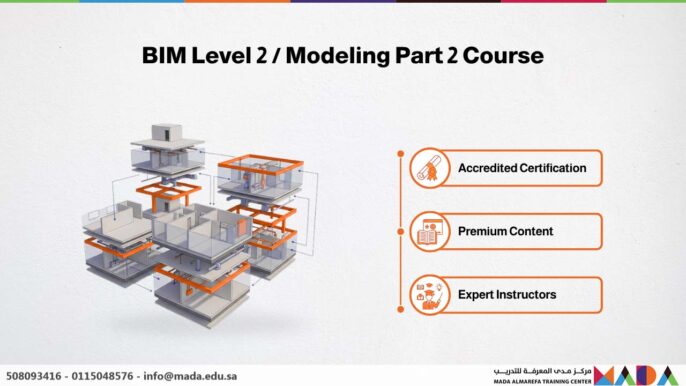
Course Overview:
The “BIM Level 2 / Modeling Part 2” course is an advanced program in Building Information Modeling, specifically designed for design and engineering professionals seeking to elevate their technical skills using BIM tools. This course provides deep theoretical knowledge that aligns with modern labor market requirements, focusing on practical applications within a virtual environment to enhance participants’ ability to manage complex projects.
Course Objectives
- Gain an in-depth understanding of BIM Level 2 concepts and their implementation phases.
- Master the software tools required for designing complex 3D models.
- Develop the ability to manage project files effectively within a BIM environment.
- Learn how to coordinate between various engineering disciplines within a BIM model.
- Develop skills for preparing accurate reports and extracting data from models.
- Enhance proficiency in using industry-leading BIM software, such as Revit.
- Build a strong theoretical background that qualifies participants to apply quality and efficiency standards in projects.
Course Curriculum
Day 1: Comprehensive Review of BIM Level 1 Fundamentals
- Core concepts of BIM Level 1.
- The differences between various BIM maturity levels.
- The importance of digital documentation in BIM projects.
- Introduction to the workspace environment in BIM software.
Day 2: Advanced 3D Modeling Applications
- Creating “Smart Objects” within the model.
- Working with Complex Families and parametric components.
- Setting up layers and components according to BIM standards.
- Customizing element properties based on specific engineering disciplines.
Day 3: Multidisciplinary Coordination in a BIM Environment
- The concept of multidisciplinary collaboration and its benefits.
- Techniques for linking structural, architectural, and MEP models.
- Theoretical study of Clash Detection.
- Preparing interdisciplinary coordination reports.
Day 4: Project Data Management and Exporting
- Extracting quantities directly from the model.
- Preparing data schedules linked to the 3D models.
- Introduction to Common Data Environments (CDE) for project information management.
- Exporting data to various formats (Excel, PDF, IFC).
Day 5: Theoretical Practical Applications and Case Studies
- Theoretical Case Study of a real-world project.
- Theoretical steps for managing a complete project at BIM Level 2.
- Understanding the role of each stakeholder in the project life cycle.
- Reviewing international best practices for implementing BIM Level 2.

