
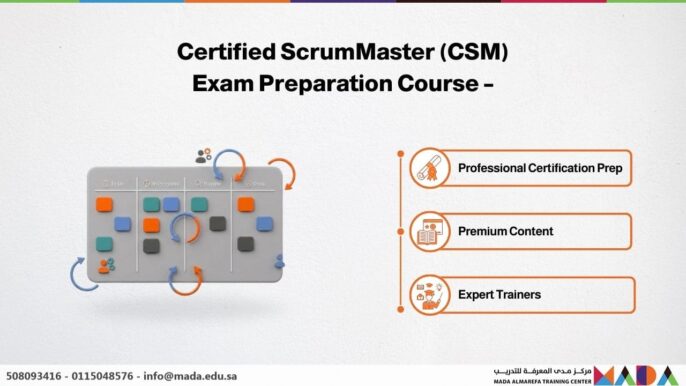
The CSM certification issued by Scrum Alliance is widely regarded as the most in-demand global standard for leaders in entrepreneurship and technical project management. This 2026 course is designed to enable you to master the Scrum framework not merely as a set of rules, but as a mindset focused on improving productivity, enhancing collaboration, and delivering high-value products in environments characterized by uncertainty.
This course does not grant a standard attendance certificate; rather, it is an intensive preparatory program specifically designed to enable you to successfully pass the official Scrum Alliance examination. The course aims to transform you into a Servant Leader capable of guiding teams toward success and operational excellence.
Course Objectives
- Internalize the five Scrum values: Courage, Focus, Commitment, Respect, and Openness.
- Understand the three pillars of Scrum: Transparency, Inspection, and Adaptation.
- Clearly define the roles and responsibilities of the Scrum Team.
- Effectively manage Scrum events to ensure smooth workflow and goal achievement.
- Empower teams to practice self-management and resolve problems internally.
- Prepare trainees to pass the CSM exam through understanding the logic of situational, scenario-based questions.
Detailed Training Content
Unit 1: Agile Philosophy and the Scrum Framework (Agile & Scrum)
- Why Scrum? Differences between traditional methodologies and Agile approaches.
- Scrum theory: empiricism and decision-making based on observation and experience.
- The Scrum lifecycle: from product vision to a potentially releasable increment.
- Practical exercises and applied questions on core Scrum principles.
Unit 2: Scrum Team Roles (Scrum Roles)
- Product Owner: maximizing value and managing the Product Backlog.
- Scrum Master: the servant leader, team coach, and impediment remover.
- Developers: accountability for quality and commitment to the Sprint goal.
- Practical exercises and applied questions on role overlap and conflict resolution within the team.
Unit 3: Scrum Events
- The Sprint: the container for all events, including duration and purpose.
- Sprint Planning: defining what will be done and how it will be accomplished.
- Daily Scrum: daily synchronization and identification of impediments.
- Sprint Review: presenting increments and obtaining stakeholder feedback.
- Sprint Retrospective: continuous improvement of team processes and collaboration.
- Practical exercises and applied questions on time management and objective alignment within events.
Unit 4: Scrum Artifacts
- Product Backlog: ordering, management, and refinement.
- Sprint Backlog: commitment to achieving the Sprint Goal.
- The Increment: understanding when work is considered done (Definition of Done).
- Practical exercises and applied questions on commitments associated with each artifact.
Unit 5: Advanced Scrum Master Skills
- Servant leadership: supporting the team without exerting control.
- Impediment management: addressing issues that hinder team performance.
- Coaching and facilitation: skills for leading effective meetings and discussions.
- Progress tracking: using burndown charts to measure team velocity.
- Practical exercises and applied questions based on real-world Scrum Master scenarios.
Official Exam Information (CSM)
| Criterion | Updated Details for 2026 |
|---|---|
| Accrediting Body | Scrum Alliance |
| Number of Questions | 50 questions |
| Question Type | Multiple Choice |
| Exam Duration | 60 minutes |
| Passing Score | 74% (37 correct answers out of 50) |
Target Audience
- Project managers seeking to transition toward Agile management approaches.
- Team leaders aiming to enhance team performance and collaboration.
- Software developers interested in professionally mastering the Scrum framework.
- Professionals responsible for driving digital transformation initiatives within organizations.
The CSM certification represents more than a credential; it is a formal recognition of your ability to lead change and build resilient, high-performing Agile teams capable of competing in a volatile job market. As such, it stands as one of the strongest professional assets you can add to your résumé in 2026.

