
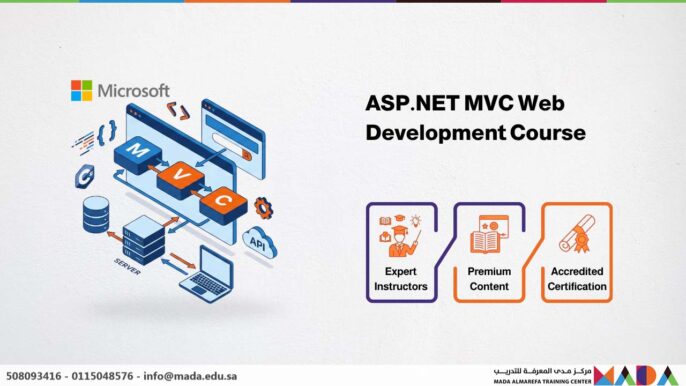
Course Overview
The ASP.NET MVC training course is a specialized program designed to provide participants with a robust theoretical understanding of web application development using Microsoft’s Model-View-Controller framework. This course is structured to deliver comprehensive knowledge regarding the MVC architecture and its critical role in building organized, maintainable web applications. The focus remains strictly on conceptual and methodological aspects, making it ideal for those who wish to master the architecture without the immediate need for field exercises.
Participants will explore essential concepts such as layer separation, HTTP request management, and URL routing. The curriculum explains the specific role of each MVC component in optimizing application structure. This systematic approach ensures a deep understanding of how the framework operates and how its components interact, catering perfectly to engineers, developers, and computer science students aiming to excel in the modern Microsoft development ecosystem.
General Objective
The primary goal of the ASP.NET MVC program is to equip trainees with a precise theoretical framework for developing web applications according to the highest software engineering standards. The program seeks to instill foundational knowledge for building scalable and maintainable applications, with a heavy emphasis on the Separation of Concerns (SoC) principle—distinguishing between business logic, user interface, and request handling.
The objective focuses on developing the ability to organize code effectively, design dynamic user interfaces, and link them to data through models. Furthermore, it introduces participants to the routing system for customizing URLs and the pivotal role of controllers in processing user requests. This course represents an advanced step toward qualifying professionals capable of contributing to the development of powerful, secure web applications using Microsoft technologies.
Detailed Learning Objectives
- Understand the ASP.NET MVC concept and its importance in modern web development.
- Identify the core components of the MVC pattern: Model, View, and Controller.
- Recognize the principle of layer separation and its impact on code organization and maintenance.
- Learn the theoretical mechanics of the Routing system in ASP.NET.
- Acquire theoretical knowledge regarding database integration within MVC applications.
Course Curriculum
Day 1: Introduction to ASP.NET MVC
- Definition of the ASP.NET MVC course and its significance in the web development landscape.
- What is the ASP.NET framework? Key differences between MVC and traditional web technologies.
- An overview of the MVC design pattern and its historical origins.
- The business value of implementing MVC in enterprise-level applications.
Day 2: Application Structure and the MVC Pattern
- The function of the Model in data representation.
- The role of the View in presenting information to the user.
- How Controllers act as the orchestrator to process requests.
- Benefits of component decoupling for improved application testability.
Day 3: The Routing System
- What is the Routing system? How does it define request paths?
- Explaining Route Configuration in ASP.NET.
- How to define Custom Routes for specific application needs.
- The importance of “Clean URLs” for user experience and Search Engine Optimization (SEO).
Day 4: Views and Data Interaction
- Understanding Views and building them using Razor Syntax.
- Theology of passing data from the Controller to the View (ViewData, ViewBag, and Strongly Typed Models).
- Theoretical overview of Layouts and Partial Views for UI consistency.
- The importance of designing flexible and dynamic user interfaces.
Day 5: Models and Database Integration
- Detailed look at Models and their relationship with data structures.
- How technologies like Entity Framework facilitate data binding.
- Theoretical look at Data Validation and its implementation within models.
- Security considerations when handling sensitive data within the MVC framework.
Conclusion and Professional Impact
The ASP.NET MVC course is a vital development tool for anyone working in web development, software engineering, or system administration within Microsoft-based environments. It contributes to building an advanced theoretical foundation for creating structured, scalable, and secure web applications using a reliable and industry-standard framework.
These skills are essential for programmers and software engineers looking to specialize in the .NET ecosystem or transition from traditional development models to modern MVC patterns. With its structured approach, the course empowers trainees to make informed engineering decisions that enhance performance and security. It is a proactive step toward qualifying a workforce capable of developing sophisticated digital solutions that meet global standards.

