
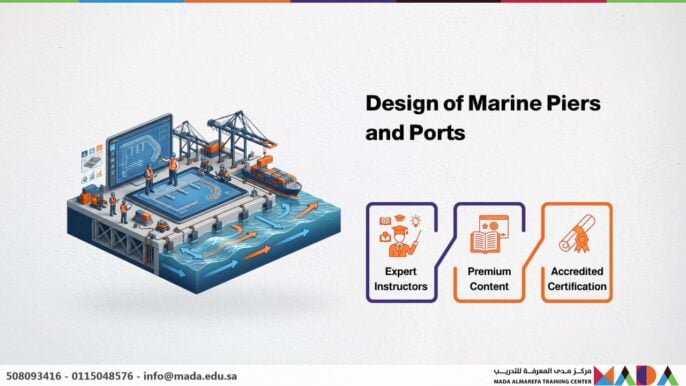
About the Course
The “Design of Marine Piers and Ports” course is a strategic opportunity for engineers and technicians to master the specialized skills required to develop the world’s most critical maritime infrastructure. As the global “Blue Economy” expands in 2026, coastal and port projects are seeing unprecedented growth. This program bridges the gap between traditional civil engineering and complex marine environments, providing a comprehensive, career-oriented roadmap for designing high-performance ports and berths.
Course Objectives
- Understand the fundamental engineering principles of marine piers and port facilities.
- Analyze Metocean (Meteorological and Oceanographic) conditions and their impact on structural design.
- Utilize modern engineering software for coastal modeling, drafting, and structural simulation.
- Implement global safety, resilience, and sustainability standards in marine environments.
- Study the economic feasibility and execution logistics of mega-scale maritime projects.
- Enhance multidisciplinary coordination between civil, hydraulic, and logistics teams.
- Deliver practical engineering solutions tailored to the specific needs of the regional and Saudi maritime markets.
Course Syllabus
Day 1: Foundations of Port and Pier Design
- Core concepts: Ports, Harbors, and Pier classifications.
- The strategic role of quay walls and jetties in global maritime trade.
- Strategic Site Selection: Bathymetry, accessibility, and hinterland connectivity.
- Case Study: Reviewing flagship maritime projects in the GCC and beyond.
Day 2: Metocean and Submerged Geotechnical Studies
Analyzing the interaction between the structure and the volatile marine environment.
- Metocean Analysis: Wave mechanics, tidal ranges, and current speeds.
- Marine Geotechnics: Soil behavior and load-bearing capacity under submerged conditions.
- Natural and Man-made Risk Assessment: Scouring, sedimentation, and seismic activity.
- Integrating environmental data into the structural design baseline.
Day 3: Structural Design of Marine Elements
Focusing on lateral pressures in submerged environments, where the effective lateral earth pressure $P_a$ is defined as:
$$P_a = \frac{1}{2} \gamma_{sub} H^2 K_a$$
- Designing Quay Walls: Gravity walls, sheet piles, and diaphragm walls.
- Structural calculations for berths: Mooring forces, berthing impact, and crane loads.
- Leveraging AutoCAD and SAP2000 for marine structural modeling.
- Practical Workshop: Designing a model marine pier section.
Day 4: Marine Construction and Execution Logistics
Addressing the unique challenges of building where the land meets the sea.
- End-to-end execution phases: Dredging, reclamation, and piling.
- Underwater Construction: Technical hurdles, corrosion protection, and siltation management.
- QA/QC (Quality Assurance/Control) in marine environments: Testing underwater concrete and welds.
- Monitoring and Evaluation: Utilizing digital sensors for long-term structural health.
Day 5: Port Economics and the Future of Marine Design
- Financial Modeling: CAPEX/OPEX estimation and ROI analysis for ports.
- Sustainability in Port Design: Eco-friendly materials and “Green Port” initiatives.
- 2026 Innovations: Automated terminals, modular piers, and resilient coastal defenses.
- Career Development: Building a personal action plan for the maritime engineering sector.

