
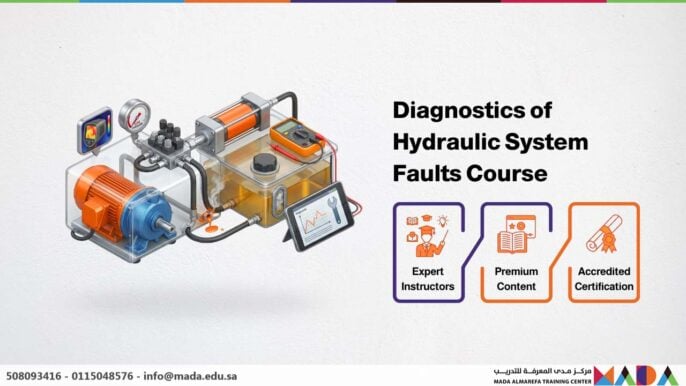
Course Overview
The Diagnostics of Hydraulic System Faults course is a specialized training program designed to meet the growing demands of the maintenance and engineering labor market. This course provides participants with the essential theoretical skills to understand hydraulic system components and accurately analyze and diagnose faults effectively. With its modern instructional design, mastering hydraulic system diagnostics empowers technicians and engineers to improve their efficiency when dealing with fluid power systems across various industrial sectors.
[Image of basic hydraulic system diagram showing pump, valves, and cylinder]
Course Objectives
- Understand the fundamental principles of hydraulic systems and the functions of their core components.
- Identify common types of hydraulic system failures and professional diagnostic methods.
- Read and review hydraulic schematics and diagrams to analyze circuits.
- Utilize theoretical diagnostic tools to determine root causes of failures without the need for physical intervention.
- Acquire problem-solving skills and evaluate hydraulic system performance.
- Apply systematic methodologies to identify appropriate solutions based on reported symptoms.
- Prepare accurate diagnostic reports regarding the condition and requirements of the hydraulic system.
Course Outline
Day 1: Fundamentals of Hydraulic Systems
- Introduction to hydraulic systems and their industrial applications.
- Primary hydraulic system components: Pumps, cylinders, valves, and reservoirs.
- The concepts of pressure and flow and their relationship within hydraulic systems.
- Review of hydraulic fluid concepts, types, and their impact on performance.
Day 2: Theoretical Reading and Analysis of Hydraulic Schematics
- Types of hydraulic diagrams (Graphic, Functional, and Circuit diagrams).
- Standard symbols for hydraulic components in schematics.
- Techniques for tracing hydraulic paths in complex diagrams.
- Theoretical case studies of common hydraulic circuits.
Day 3: Common Faults in Hydraulic Systems
- Classification of faults: Mechanical, hydraulic, or fluid-related issues.
- Common fault symptoms: Pressure drops, leaks, excessive noise, and overheating.
- The impact of wear, tear, and contamination on system performance.
- Preventive measures to avoid failures and extend system lifespan.
Day 4: Methodologies for Theoretical Fault Diagnosis
- Systematic steps for diagnosing faults through theoretical analysis.
- Using theoretical analysis tools (Maintenance logs, schematics, and technical data).
- Correlating symptoms with potential root causes.
- Studying typical fault scenarios and their analysis.
Day 5: Practical Applications and Theoretical Case Studies
- Comprehensive review and theoretical analysis of previous failure cases.
- Methodologies for writing precise diagnostic reports.
- Simulation of hydraulic problems based on provided data sets.
- Discussion on decision-making strategies for selecting the most effective solutions.

