
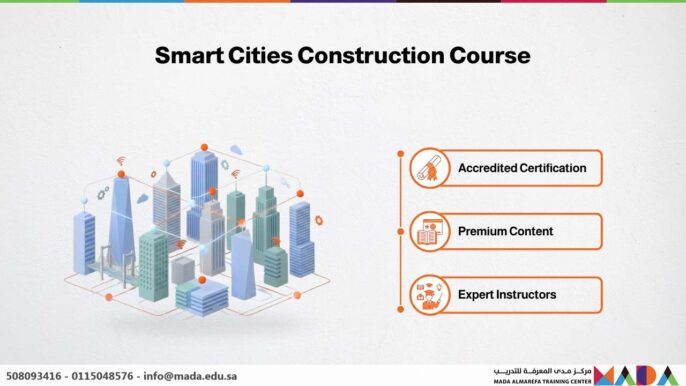
Course Overview:
The Smart Cities Construction course offers a unique opportunity for students and urban development professionals to explore the latest concepts and technologies used in the design and development of smart cities. The course focuses on bridging the gap between theory and practice by explaining the technological and administrative foundations upon which modern urban projects are built. This makes it one of the most relevant programs for the labor market in the era of digital transformation. Through this training program, participants will gain the essential skills to understand how to build sustainable and intelligent urban environments.
Course Objectives
- Understand the concept of smart cities and their significance in the 21st century.
- Identify the key technologies used in building smart cities, such as the Internet of Things (IoT) and Big Data.
- Grasp the principles of sustainability and smart urban planning in development projects.
- Study successful global models of smart cities and analyze their practical applications.
- Understand the role of e-government and smart transportation systems in urban development.
- Identify cybersecurity challenges and data management strategies in smart cities.
- Participate in designing preliminary strategic plans for future smart city projects.
Course Curriculum
Day 1: Introduction to Smart Cities
- Definition of a Smart City and its core concepts.
- The importance of smart cities in achieving sustainable development.
- An overview of leading countries in smart city development.
- Challenges facing the implementation of smart city projects.
Day 2: Technologies Powering Smart Cities
- Introduction to Internet of Things (IoT) technologies and their applications.
- Utilizing Big Data for informed urban decision-making.
- The role of Artificial Intelligence (AI) in managing municipal services.
- The impact of Blockchain on smart city governance.
Day 3: Smart Urban Planning and Sustainability
- Principles of urban planning within smart cities.
- Strategies for achieving environmental and economic sustainability.
- Designing green spaces and eco-friendly buildings.
- Renewable energy systems and their distribution within smart urban grids.
Day 4: Smart City Services and Applications
- Smart Transportation Systems (ITS) and optimizing traffic flow through technology.
- Smart waste management and recycling technologies.
- Developing health and education services via smart networks.
- Enhancing the efficiency of government services through digital transformation.
Day 5: Future Challenges and Project Management
- Cybersecurity and protecting smart city data infrastructure.
- Funding mechanisms for smart city projects.
- Case Study: The “NEOM” project.
- Practical steps for designing a preliminary smart city blueprint.

