
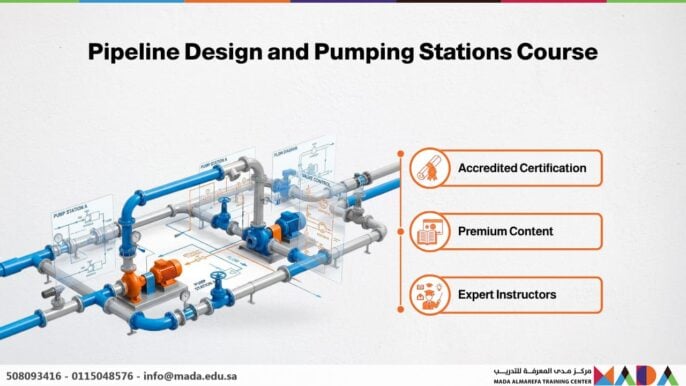
About the Course
The “Pipeline Design and Pumping Stations” course offers a premium opportunity to master the engineering fundamentals of fluid and gas transport systems. These skills are mission-critical in the oil and gas, chemical processing, and wastewater management sectors, making them some of the most sought-after competencies in the 2026 labor market. This course empowers trainees with modern analytical and design tools to handle complex network infrastructures with professional efficiency.
Course Objectives
- Understand the fundamental hydraulic and mechanical concepts required for transport system design.
- Apply international engineering codes and standards (such as ASME B31.4/B31.8 and API).
- Define design requirements for pumping stations based on the fluid medium (liquid vs. gas).
- Calculate pressure losses ($\Delta P$) and determine optimal pipe sizing using hydraulic modeling.
- Analyze the impact of environmental and operational variables on network integrity.
- Select appropriate equipment, including pumps, valves, and specialized pumping units.
- Perform theoretical system analysis under diverse operating conditions.
Course Syllabus
Day 1: Introduction to Pipeline Engineering
- Scope and overview of pipeline design and pumping station integration.
- Classifying pipeline systems by utility, material, and transported medium.
- Review of piping materials (Carbon steel, HDPE, GRP) and selection criteria.
- Safety protocols and environmental protection standards in transport design.
Day 2: Fluid and Gas Dynamics in Pipelines
Focusing on Hydraulic Analysis to ensure efficient transport without system failure.
- Principles of aerodynamics and fluid mechanics in closed conduits.
- Calculating head loss ($h_f$) and its impact on system sizing.
- The relationship between flow velocity, pressure gradients, and viscosity.
- Analyzing flow patterns in straight sections vs. elbows and fittings.
Day 3: Pumping Station Design and Network Layout
Designing the “heart” of the transport system to maintain steady flow over long distances.
- The role of pumping stations in long-distance transport and grid injection.
- Classifying pump types: Centrifugal vs. Positive Displacement.
- Optimizing station locations and integration with the main network.
- Economic analysis: Selecting sites based on operational costs and mechanical efficiency.
Day 4: Environmental Factors and System Protection
- Impact of ambient temperature, soil conditions, and climate on pipeline integrity.
- Managing Thermal Expansion and structural stresses.
- Advanced protection: Insulation, coatings, and Cathodic Protection.
- Structural planning for fixed vs. floating installations.
Day 5: Applied Case Studies and Theoretical Analysis
- Reviewing real-world case studies of successful pipeline network designs.
- Steps to developing a preliminary P&ID (Piping and Instrumentation Diagram).
- Cost-benefit analysis and efficiency auditing for pumping systems.
- Risk mitigation: Predicting future design failures and implementing preventive solutions.

