
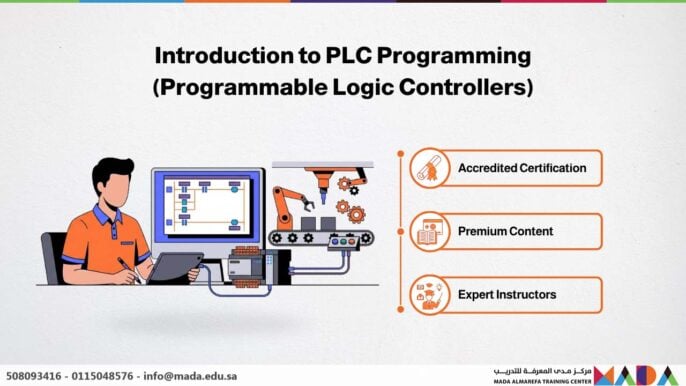
About the Course
The Introduction to PLC Programming (Programmable Logic Controllers) course is an ideal starting point for learners embarking on a journey into the world of industrial automation. This program covers the foundational principles of programming, the architectural structure of PLC systems, and real-world applications in automated control.
As industries increasingly shift toward Industry 4.0, this course addresses the growing demand for skilled technical personnel in the industrial and technology sectors, making it a critical first step for anyone seeking a successful career in automation.
Course Objectives
- Understand the core concept of a PLC and its fundamental operational principles.
- Identify the various types of PLCs and their specific industrial applications.
- Learn the principles of programming using industry-standard languages, specifically Ladder Logic.
- Study the electrical system architecture and its integration with PLC circuits.
- Analyze the primary applications of controllers in various automation processes.
- Develop a preliminary design for a small-scale project utilizing PLC technology.
- Enhance skills in interpreting technical diagrams and wiring schematics.
Course Curriculum
Day 1: Introduction to PLC and its Applications
- Defining Programmable Logic Controller (PLC) programming.
- A comparative analysis: Traditional relay logic vs. PLC systems.
- The role of PLCs across diverse industrial sectors.
- The strategic importance of mastering PLC programming in the modern workforce.
Day 2: PLC Hardware Components and Classifications
- Exploring the internal architecture of the Programmable Logic Controller.
- Understanding I/O Modules (Input and Output types).
- Power supplies, Central Processing Units (CPUs), and communication ports.
- Selection criteria: Choosing the right PLC type for specific industrial applications.
Day 3: Programming Fundamentals and Languages
- Introduction to standard PLC programming languages (IEC 61131-3).
- In-depth explanation of Ladder Logic: The most common industrial language.
- Writing a foundational PLC program using Ladder symbols.
- Understanding the relationship between the software code and the physical electrical circuit.
Day 4: Circuit Analysis and Logic Programming
- Methodologies for converting electrical schematics into PLC programs.
- Utilizing logic elements: Coils, Contacts, Timers, and Counters.
- Practical analysis of logic gate applications (AND, OR, NOT).
- Practical software application: Creating a program to manage an electric motor.
Day 5: PLC Project Design and Prototyping
- Step-by-step framework for designing a primary PLC-based project.
- Analyzing project requirements and drafting a programming plan.
- Implementing a prototype model for monitoring a simulated industrial process.
- Overview of future trends and advancements in PLC technology.

