
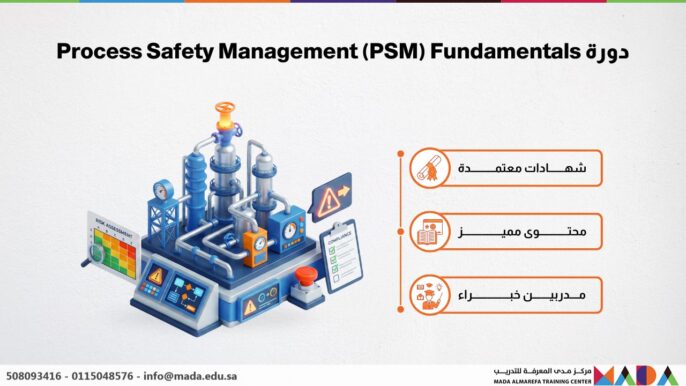
This course provides you with the foundational principles of Process Safety Management (PSM), with a particular focus on chemical hazards in agricultural factory environments. You will learn about the PSM system and its importance in preventing major accidents, as well as how to develop safe work procedures for handling chemicals such as chlorine, ammonia, and industrial disinfectants. Additionally, the course addresses the role of Management of Change (MOC) and routine maintenance in ensuring facility safety, along with the importance of fostering a corporate culture that places safety at the heart of every operational process.
Target Audience
This course is designed for the following groups:
- Operations and production engineers in agricultural and industrial factories.
- Occupational safety supervisors and specialists.
- Maintenance managers and technicians responsible for equipment.
- Quality and compliance officers.
- Emergency response and internal audit teams.
Course Modules
The modules are distributed over four days as follows:
Day One: Introduction and Elements of the PSM System
- The concept of Process Safety Management and its role in protecting lives and property.
- The importance of PSM in industries dealing with hazardous chemicals.
- Review of major global accidents and their links to poor process management.
- Key elements of the PSM system according to international standards such as OSHA.
- Importance of technical chemical data (MSDS/SDS) in the agricultural workplace.
- Examples of PSM implementation in food and beverage factories.
Day Two: Chemical Hazards and Safe Work Procedures
- Types of chemicals commonly found in agricultural environments (cleaners, disinfectants, pesticides).
- Routes of chemical exposure such as inhalation and skin contact.
- Risk assessment of chemical hazards using approved methodologies.
- Developing safe work procedures for handling chemicals.
- Importance of training employees on hazardous material handling.
- A hypothetical case study on implementing PSM in chemical production or storage.
Day Three: Management of Change, Maintenance, and Equipment Qualification
- The concept of Management of Change (MOC) and its importance during modifications or equipment replacement.
- Mechanical maintenance requirements for pipes, tanks, and valves.
- Qualification and inspection of critical equipment and the role of documentation in compliance.
- Emergency management and incident investigation within the PSM framework.
Day Four: Compliance and Organizational Culture for Process Safety
- The role of periodic audits in verifying system effectiveness.
- Senior management’s responsibility in supporting a process safety culture.
- The relationship between PSM, regulatory compliance, and the consequences of negligence.
- Building a process safety culture as part of corporate identity.
Course Objectives
This course aims to enable you to:
- Understand the components and importance of the Process Safety Management (PSM) system.
- Identify common chemical hazards in agricultural and industrial workplaces.
- Develop safe work procedures for handling hazardous chemicals.
- Promote a culture of safety and adherence to international standards.
- Gain the ability to participate in PSM system reviews and audits.
Course Impact
The value of this course is reflected on both the trainee and the institution:
On the Trainee
- Enhance your expertise in handling hazardous chemicals.
- Improve your efficiency in implementing process safety procedures.
- Strengthen your career prospects in operations, maintenance, and safety roles.
On the Institution
- Reduce the likelihood of major incidents involving hazardous chemicals.
- Improve compliance with international safety standards.
- Enhance the institution’s reputation and public trust.
- Ensure business continuity and minimize downtime due to accidents.
The Process Safety Management (PSM) Fundamentals Course is not just an additional training, but a cornerstone for any industrial facility dealing with hazardous materials. It transforms safety from a routine procedure into an integrated system that protects lives, property, and the environment. Participating in this course is a genuine investment in your safety and that of your organization, ensuring continued operations with confidence and high efficiency.

