
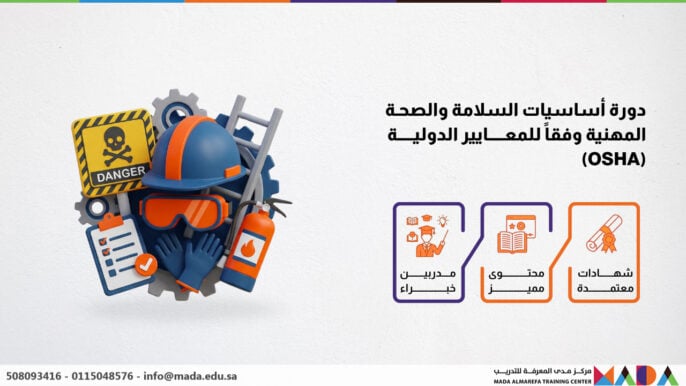
The Fundamentals of Occupational Safety and Health According to International Standards (OSHA) Course is a foundational training program aimed at raising professional awareness and improving the work environment across various industrial and service sectors. The course offers comprehensive theoretical content based on the standards of the U.S. Occupational Safety and Health Administration (OSHA), with the goal of establishing a safe and healthy work environment that reduces occupational injuries and illnesses. The course emphasizes core concepts and policies in occupational safety without requiring field applications, making it suitable for all professionals and individuals interested in the field of occupational safety and health.
At the end of the course, participants receive an accredited certificate in both Arabic and English from the Technical and Vocational Training Corporation (TVTC). No final exam is required for this course.
Target Audience
This course is designed for individuals seeking to enhance their knowledge in occupational safety and health, including:
- Safety supervisors and administrators in industrial and service facilities.
- Human resources and personnel officers.
- Team leaders and fieldwork supervisors.
- Students and individuals pursuing a career path in occupational safety.
Course Modules
The course modules are spread over five training days as follows:
Day One: Introduction to Occupational Safety and Health
- Definition and importance of occupational safety and health in the modern workplace.
- The role of OSHA in establishing international safety standards.
- Comparison between traditional and modern safety concepts.
- The relationship between a safe work environment and productivity.
Day Two: OSHA Standards and Applications
- Overview of key OSHA standards across various sectors.
- Requirements for implementing standards within institutions and facilities.
- The link between OSHA regulations and local legislation.
- Management’s responsibilities in ensuring compliance with standards.
Day Three: Hazard Identification and Management
- Classification of workplace hazards (physical, chemical, mechanical, behavioral).
- Use of occupational risk assessment tools.
- The concept of risk management according to OSHA practices.
- Establishing controls to mitigate risks before they occur.
Day Four: Preventive Policies and Procedures
- Developing internal safety policies in the organization.
- Preparing emergency response and evacuation plans.
- The importance of continuous training and awareness for employees.
- Monitoring and evaluating the effectiveness of preventive measures.
Day Five: Organizational Culture and Professional Responsibility
- The leadership role in promoting a safety culture in the workplace.
- Legal and ethical responsibilities of employees and management.
- Internal communication methods to raise safety awareness.
- Real case studies analyzed according to OSHA principles.
Course Objectives
This course aims to enable participants to:
- Understand OSHA standards and concepts related to occupational safety.
- Identify common workplace hazards and preventive methods.
- Develop safety policies and procedures within organizations.
- Promote a culture of safety and professional responsibility.
- Support compliance with local and international occupational safety regulations.
Course Impact
Benefits for the Trainee
- Increase awareness of workplace hazards and how to mitigate them.
- Gain theoretical knowledge to understand and apply OSHA standards.
- Improve the ability to actively participate in occupational safety planning.
Benefits for the Organization
- Reduce occupational injury rates and improve overall performance.
- Enhance compliance with international standards and avoid regulatory penalties.
- Improve the organization’s reputation as a safe and healthy workplace.
The Fundamentals of Occupational Safety and Health According to International Standards (OSHA) Course serves as a cornerstone for any safe and well-structured work environment. It provides participants with deep insights into prevention concepts and risk management, and contributes to building a corporate culture rooted in responsibility and safety. This course is an ideal opportunity for personal development and advancing professional knowledge in alignment with modern global standards.

