
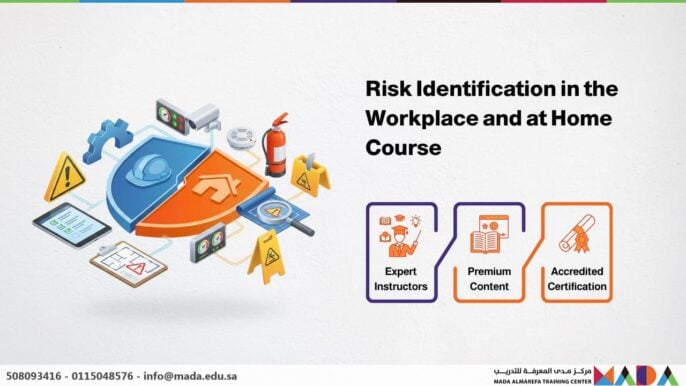
Course Overview
The Risk Identification in the Workplace and at Home course is an advanced theoretical training program designed to establish a comprehensive understanding of methods for identifying potential hazards in two primary daily environments: the workplace and the home. This course focuses on theoretical frameworks that enhance the ability to analyze surroundings, pinpoint sources of danger, and implement preventive measures to avoid accidents and injuries.
Delivered entirely in a theoretical format—without the need for field visits or practical exercises—this program is ideal for employees, individuals, families, and safety supervisors seeking to build a total security awareness. The curriculum covers physical, electrical, chemical, and behavioral risks, alongside emergency planning and the vital role of a proactive safety culture. It also highlights risk assessment tools, scenario analysis, and emergency response protocols for offices, factories, and residential settings.
General Objective
The program aims to empower participants with an in-depth theoretical understanding of early hazard recognition, with a specific focus on applying assessment skills across both professional and personal contexts. It seeks to build trainees’ capacity to analyze environments from a safety perspective, understand hazard identification, and make preventive decisions that significantly reduce the likelihood of accidents. This program does not require prior experience in occupational safety; it presents concepts in an analytical and organized manner to build a holistic vision of daily risk prevention.
Detailed Objectives
- Understand the fundamental concepts of risk identification and its importance in daily life.
- Identify types of workplace hazards: physical, electrical, chemical, and behavioral.
- Recognize common household risks: electrical faults, leaks, falls, and fires.
- Learn how to evaluate risk levels using simplified theoretical tools.
- Comprehend the role of awareness, training, and emergency planning in accident reduction.
Course Modules
Day 1: Introduction to Risk Identification
- Defining risks and their categories: Natural, human, technical, and environmental.
- Distinguishing between Hazard, Threat, and Accident.
- The strategic importance of risk prevention at work and home.
- Case studies of avoidable accidents through early detection.
Day 2: Hazards in the Workplace
- Physical Hazards: Falls, trips, noise pollution, and vibrations.
- Electrical Hazards: Exposed wiring, circuit overloading, and faulty equipment.
- Chemical Hazards: Exposure to toxins, vapors, and industrial dust.
- Behavioral Hazards: Negligence, haste, and non-compliance with safety protocols.
Day 3: Hazards in the Home
- Electrical Safety: Unsafe connections and using appliances near water sources.
- Fire Risks: Kitchen safety, candles, and heating devices.
- Fall Hazards: Stairways, slippery floors, and lack of handrails.
- Leakage Risks: Gas, water, and household chemical storage.
Day 4: Risk Assessment and Prevention Tools
- The concept of Risk Assessment: Identification, Analysis, Evaluation, and Control.
- Utilizing theoretical Checklists for hazard assessment.
- The Risk Matrix: Assessing severity versus probability.
- Prevention Strategies: Elimination, substitution, engineering controls, and administrative procedures.
Day 5: Emergency Planning and Safety Culture
- Workplace emergency plans: Evacuation, first aid, and alarm protocols.
- Home emergency plans: Fire extinguishers, emergency exits, and smoke detectors.
- The importance of continuous theoretical training and awareness.
- The Future of Safety: Smart homes, sensory devices, and AI integration.
Conclusion: Strategic Impact
The Risk Identification in the Workplace and at Home course is a pivotal element in building total safety awareness for individuals in every aspect of life. This course is of high importance for employees, families, and safety officers in both public and private institutions. By fostering a proactive approach to risk management, the program protects lives and property while reducing the costs associated with accidents. In a complex modern world, mastering hazard identification is essential for ensuring stability and achieving a sustainable, safe environment.

