
Course Overview
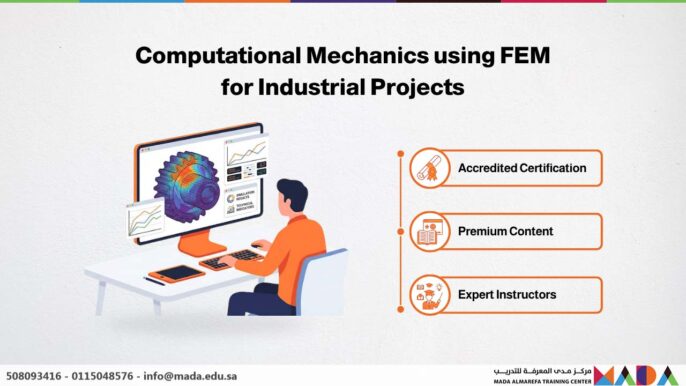
The Computational Mechanics using FEM for Industrial Projects course offers a unique opportunity to understand the fundamentals of numerical analysis using the Finite Element Method (FEM) in mechanical engineering applications. This course is designed to meet the demands of the modern labor market by equipping engineers and practitioners with the theoretical knowledge required to analyze complex systems with high efficiency and precision.
Course Objectives
- Understand the fundamental principles of the Finite Element Method (FEM) and its applications in mechanical engineering.
- Analyze engineering problems using accurate mathematical and computational models.
- Utilize numerical simulation tools to study the behavior of materials and structures under various conditions.
- Apply computational mechanics concepts to industrial projects using a rigorous scientific approach.
- Interpret computational results and draw appropriate conclusions to optimize engineering performance.
- Build theoretical knowledge bases that support decision-making in the design of industrial projects.
- Handle complex load cases and structural responses using advanced FEM techniques.
Course Outline
Day 1: Introduction to Computational Mechanics and FEM
- The concept of computational mechanics and its strategic importance in industrial applications.
- A brief history of the evolution of the Finite Element Method.
- The relationship between applied mathematics and numerical simulation.
- Stages of implementing FEM to analyze and solve engineering problems.
Day 2: FEM Model Basics and Numerical Mesh Generation
- Steps for building an FEM model: From geometric characterization to Boundary Conditions.
- Types of FEM elements and their specific characteristics (1D, 2D, and 3D elements).
- Techniques for building an accurate numerical mesh and the impact of Mesh Density on results.
- Selecting the appropriate element types based on the nature of the industrial project.
Day 3: FEM Applications in Stress and Strain Analysis
- Analyzing internal stresses and deformations resulting from mechanical loads.
- Linear and non-linear material models in FEM applications.
- Studying stress distribution and concentration in industrial structures.
- Theoretical examples of common engineering problems and their computational solutions.
Day 4: Dynamics and Vibrations using FEM
- Utilizing FEM for the analysis of natural and forced vibrations.
- Analyzing the dynamic stability of industrial structures.
- Studying the impact of natural frequencies on machine design and integrity.
- The concept of Time-History Analysis using FEM in industrial projects.
Day 5: Advanced Applications and Theoretical Case Studies
- Thermal analysis and heat transfer simulation using FEM.
- Multiphysics Analysis: Integrating multiple physical phenomena (e.g., thermal and structural stress) into a single analysis.
- Theoretical case study: Analyzing a large-scale industrial project using FEM methodologies.
- An overview of industry-standard simulation software and their specific application areas.

