
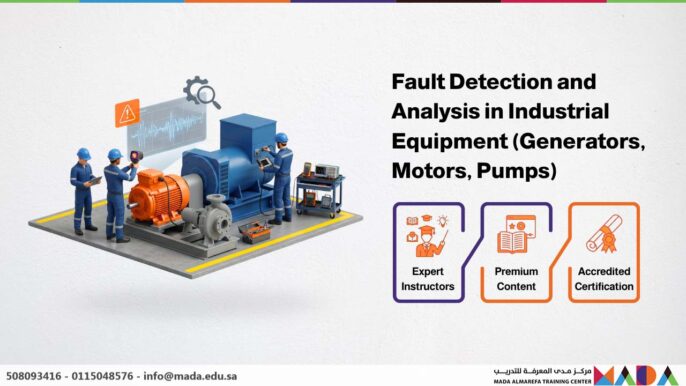
Course Overview
The Fault Detection and Analysis in Industrial Equipment course is a specialized program designed to meet the growing demands of the maintenance and operations market. This course provides the theoretical foundation necessary to understand the root causes of equipment failure and master the art of accurate diagnosis. By learning to identify issues before they lead to catastrophic failure, professionals can significantly enhance operational efficiency and reduce unplanned downtime. Offered by the Mada Al-Maarifa Training Center, this course utilizes an innovative educational approach tailored specifically for engineers and technicians in the industrial sector.
Course Objectives
- Understand the fundamental concepts and principles of fault detection and analysis.
- Identify common failure modes in generators, electric motors, and industrial pumps.
- Utilize theoretical analysis tools and techniques to diagnose equipment health without needing physical intervention.
- Interpret and analyze performance data to identify hidden mechanical or electrical issues.
- Make informed technical decisions based on analysis results to optimize equipment lifespan.
- Prepare professional preliminary diagnostic reports for industrial assets.
- Bridge the gap between fault theory and real-world industrial applications.
Course Curriculum
Day 1: Introduction to Industrial Equipment Faults
- The concept of “failure” and the classification of fault types in heavy machinery.
- The strategic importance of early detection in a proactive Preventive Maintenance framework.
- How external environmental factors (heat, humidity, dust) impact equipment integrity.
- Introduction to condition monitoring using theoretical performance indicators.
Day 2: Generator Fault Analysis
- Exploring common electrical and mechanical faults in power generators.
- Analyzing voltage drops and current fluctuations and their impact on performance.
- Understanding frequency slip and the resulting structural vibrations.
- Protection protocols and theoretical countermeasures against generator failure.
Day 3: Electric Motor Faults and Diagnostic Methods
- Classification of motor faults: Stator, Rotor, and Bearing issues.
- Analyzing electrical circuit faults and insulation degradation.
- Interpreting motor nameplate data and theoretical performance curves for diagnosis.
- The destructive effects of chronic overload and thermal variations on motor windings.
Day 4: Pump Fault Analysis
- Overview of industrial pump types and their unique operational characteristics.
- Identifying the “Big Three” pump issues: Vibration, Noise, and Efficiency Drop.
- Analyzing the relationship between pressure, flow rates, and internal system faults.
- The impact of erosion, corrosion, and seal leaks on overall pump performance.
Day 5: Advanced Analytical Tools and Techniques
- Introduction to the theoretical analysis tools used in modern industry (e.g., Root Cause Analysis).
- Utilizing simulation concepts to model performance data and predict failures.
- Interpreting “Early Warning” indicators in digital monitoring systems.
- Developing a technical decision-making framework based on analytical findings.
Conclusion
In the modern industrial landscape, a technician who can “listen” to a machine through its data is worth their weight in gold. This course provides the structural knowledge required to move from reactive repairs to precision analysis. By mastering the theoretical indicators of failure in Generators, Motors, and Pumps, participants become vital assets to their organizations, ensuring that the wheels of industry keep turning safely and efficiently.

