
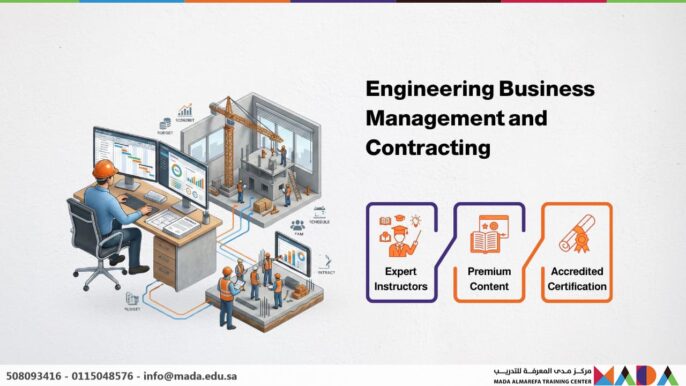
About the Course
The “Engineering Business Management and Contracting” course offers a golden opportunity to develop the strategic managerial and technical skills required to lead high-stakes engineering and construction projects. This program serves as a bridge between technical engineering expertise and modern management practices, aligning with the 2026 labor market needs for precision planning, monitoring, and control. By mastering this course, participants will gain practical tools to optimize project performance and maximize profitability in a competitive industry.
Course Objectives
- Understand the fundamental concepts of engineering business management.
- Master the essential skills for managing contracting projects effectively and efficiently.
- Enhance the ability to plan and organize human and material resources across multi-phase projects.
- Develop high-level negotiation and stakeholder management skills (Clients & Suppliers).
- Learn proactive Risk Management strategies tailored for the engineering sector.
- Acquire professional pricing, tendering, and financial analysis skills for contracting bids.
- Build a comprehensive end-to-end project management plan from inception to handover.
Course Syllabus
Day 1: Introduction to Engineering Business Management
- Core concepts: Why business management is vital for the modern engineering market.
- Technical vs. Administrative: Bridging the gap between traditional management and engineering project management.
- The role of the Engineering Project Manager: Competencies and responsibilities.
- The intersection of engineering disciplines and operational management.
Day 2: Fundamentals of Contracting Project Management
- Overview of engineering project types and the hierarchy of main contractors vs. subcontractors.
- The strategic role of Contract Administration in project success.
- Designing organizational structures and defining responsibility matrices.
- Introduction to preliminary planning tools: The Gantt Chart.
Day 3: Strategic Planning and Scheduling
Mastering time management through the Critical Path Method (CPM).
- Advanced scheduling techniques using CPM and PERT.
- Precise time and cost estimation for individual project milestones.
- Effective resource allocation: Balancing human capital and material logistics.
- Monitoring, updating, and re-baselining schedules in response to site realities.
Day 4: Cost Management and Budgeting
Focusing on financial discipline where the Variance is calculated as:
$$\text{Variance} = \text{Planned Budget} – \text{Actual Expenditure}$$
- Concepts of Estimated vs. Actual budgets in engineering ventures.
- Tools for financial monitoring: Cost Control and expenditure tracking.
- Financial Variance Analysis: Identifying and treating budget overruns.
- Preparing professional financial reports for stakeholders and executive management.
Day 5: Risk Management and Stakeholder Communication
- Risk classification: Technical, financial, and environmental risks in contracting.
- Mitigation strategies and developing robust contingency plans.
- The power of effective communication: Coordinating between owners, consultants, and contractors.
- Utilizing Management Information Systems (MIS) to enhance team coordination.

