
About the Course
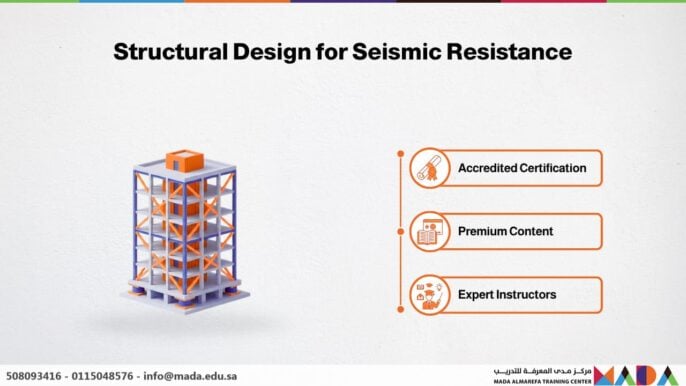
The Structural Design for Seismic Resistance course is a specialized program designed to meet the rigorous demands of the 2026 civil and structural engineering labor market, particularly in seismically active regions. This course provides engineers with the essential theoretical framework and practical skills required to design buildings and infrastructures that withstand seismic forces in full compliance with global standards.
Course Objectives
- Understand fundamental earthquake concepts, types, and their specific impacts on various structures.
- Master structural design based on seismic resistance standards according to international codes.
- Gain proficiency in using structural analysis software to simulate seismic loads accurately.
- Enhance expertise in selecting the most effective Lateral Force Resisting Systems (LFRS) for diverse projects.
- Identify common pitfalls in seismic design and implement strategies to avoid them.
- Study structural safety requirements and resilience in the face of seismic events.
- Apply flexible and creative design principles to minimize earthquake-induced damage.
Course Syllabus
Day 1: Introduction to Earthquakes and Structural Impacts
- Core concepts of seismology: Causes, classifications, and wave propagation.
- How earthquakes impact different types of structures (resonance and displacement).
- Criteria for seismic hazard assessment in specific geographic zones.
- Preliminary review of international standards: ASCE 7 and IBC.
Day 2: Fundamentals of Seismic Structural Design
- Concepts of dynamic structural response and vibration periods.
- Characteristics of structural systems under seismic loading.
- Classification of Lateral Force Resisting Systems (LFRS).
- The importance of stiffness, ductility, and precision in seismic-resistant design.
Day 3: Seismic Load Analysis
Focusing on the mathematical calculation of seismic forces, including base shear $V$ using the formula:
$$V = C_s W$$
where $C_s$ is the seismic response coefficient and $W$ is the effective seismic weight.
- Seismic load calculation methods: Equivalent Static Analysis vs. Dynamic Analysis.
- Utilizing site coefficients and spectral acceleration parameters.
- Response Spectrum Analysis and its application to structural models.
- Case Study: Analyzing a residential building using seismic simulation software.
Day 4: Designing Seismic-Resistant Elements
- Designing structural elements (Shear walls, Beams, Columns) to withstand seismic forces.
- Structural connection design for enhanced energy dissipation.
- Applying seismic detailing requirements according to ACI 318 Appendix D.
- Practical examples: Designing steel frames vs. reinforced concrete structures for seismic zones.
Day 5: Applications and Challenges in Seismic Design
- Analysis of common technical problems in seismic-resistant design.
- Selecting the optimal seismic system based on project type and height.
- Reviewing Soil-Structure Interaction (SSI) during seismic events.
- Comprehensive review and showcase of real-world case studies from successful global projects.

