
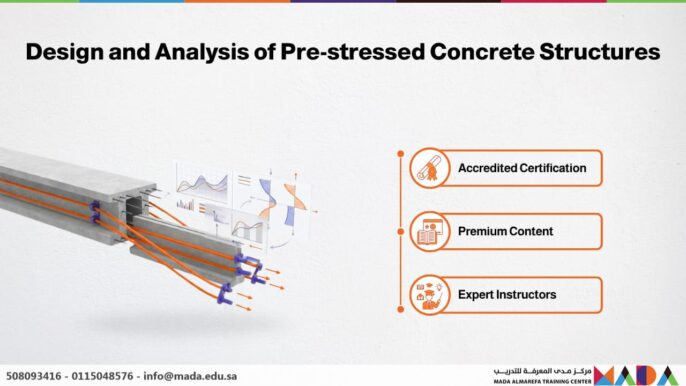
About the Course
The “Design and Analysis of Pre-stressed Concrete Structures” course is a highly specialized program designed to meet the rigorous demands of the 2026 civil engineering and construction sectors. This course provides advanced theoretical and practical insights into the principles of design and analysis for pre-stressed concrete systems, utilizing the latest global standards. It is an essential step for engineers looking to master high-performance structural systems used in mega-projects.
Course Objectives
- Understand the core concepts and fundamental mechanics of pre-stressed concrete.
- Master the application of international design codes, such as ACI 318 and Eurocode 2.
- Analyze structural behavior under diverse loading conditions with high precision.
- Gain proficiency in interpreting results from advanced structural analysis software.
- Apply modern design methodologies to enhance structural resistance and durability.
- Identify and mitigate common design and execution pitfalls.
- Enhance expertise in the design and analysis of bridges, high-rise structures, and long-span girders.
Course Syllabus
Day 1: Introduction to Pre-stressed Concrete
- Core concepts of pre-stressing and its historical evolution.
- Detailed comparison: Pre-Tensioning vs. Post-Tensioning.
- Reinforced Concrete vs. Pre-stressed Concrete: Advantages and limitations.
- High-strength materials: Tendons, strands, and high-performance concrete (HPC).
- Modern applications: From bridges to containment structures.
Day 2: Fundamental Design Principles
Focusing on the distribution of internal stresses where the total stress $f$ is calculated as:
$$f = \frac{P}{A} \pm \frac{Pe \cdot y}{I} \pm \frac{M \cdot y}{I}$$
- Internal stress distribution in concrete sections.
- Pressure lines (C-lines) and thrust lines (T-lines) in design.
- Selecting optimal cross-sections for various structural elements.
- Preliminary review of global standards (ACI 318, Eurocode 2).
Day 3: Structural Behavior Analysis
- Flexural and shear analysis of pre-stressed members.
- Long-term effects: Understanding Creep and Shrinkage.
- Losses in pre-stress: Elastic shortening, friction, and anchorage slip.
- Cracking analysis and serviceability limit states (SLS).
- Case Study: Analyzing a pre-stressed concrete girder.
Day 4: Structural Element Design
- Design of pre-stressed slabs, beams, and hollow-core units.
- Calculation of active reinforcement (tendons) and passive reinforcement (mild steel).
- Designing high-stress anchorage zones and connections.
- Practical design project: Analysis and design of a pre-stressed bridge girder.
Day 5: Applications, Challenges, and Future Trends
- Troubleshooting common issues in design and site execution.
- Choosing the appropriate pre-stressing system based on project requirements.
- Seismic performance and environmental durability of pre-stressed structures.
- Comprehensive review of real-world mega-projects and advanced case studies.

