
About the Course
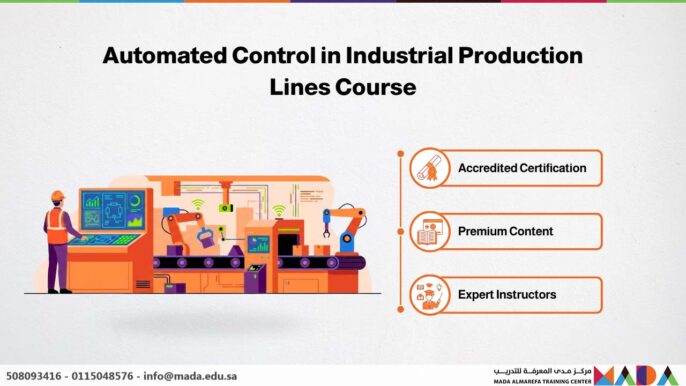
The Automated Control in Industrial Production Lines course is a specialized program designed to keep pace with the demands of the modern industrial labor market. It focuses on the fundamental concepts of automated systems utilized in factories and high-capacity production facilities.
This course empowers trainees to acquire the essential skills required to understand and analyze industrial control systems. By enhancing their technical capabilities, participants will be able to contribute to the development of production processes with increased efficiency and operational effectiveness.
Course Objectives
- Understand the core concepts and architectures of automated control systems in industrial environments.
- Identify key components of control systems, including PLCs, sensors, and actuators.
- Analyze how control systems integrate with production lines to achieve optimal operational efficiency.
- Master the use of industry-standard software and tools for designing and simulating automated control systems.
- Learn diagnostic methodologies and preventive maintenance techniques for industrial control hardware.
- Apply theoretical principles to actively improve the performance of existing production lines.
- Enhance career development and employment opportunities by mastering the competencies required for Industry 4.0.
Course Curriculum
Day 1: Introduction to Automated Control Systems
- The concept of automated control and its vital role in modern industrial production.
- Classification of control systems: Analog vs. Digital.
- Basic automated system components: Sensors, valves, and motors.
- The role of Industrial PCs (IPCs) in modern automation.
Day 2: Introduction to PLC (Programmable Logic Controllers)
- Defining the PLC and its specific functions within industrial sectors.
- Anatomy of a PLC unit: Exploring input/output (I/O) modules.
- Fundamental concepts of PLC programming using Ladder Logic.
- Practical examples of PLC applications across various production lines.
Day 3: Hardware Integration and Device Communication
- The concept of Hardware Integration within a control network.
- Types of industrial sensors and their strategic implementation in control loops.
- Control methodologies for actuators and executive devices.
- Communication protocols and networking: Fieldbus, Ethernet/IP, and others.
Day 4: Design and Simulation of Control Systems
- Introduction to professional simulation software used in industrial automation.
- Workflow steps for designing an automated control project.
- Practical Application: Designing a control system for an industrial elevator.
- Result analysis and performance optimization techniques.
Day 5: Maintenance and Optimization of Industrial Systems
- The philosophy of preventive maintenance for sensitive control systems.
- Diagnostic procedures for identifying and fixing common automation faults.
- Techniques for enhancing production line efficiency through “Smart Control.”
- The future of automated control in the era of the Fourth Industrial Revolution (Industry 4.0).

