
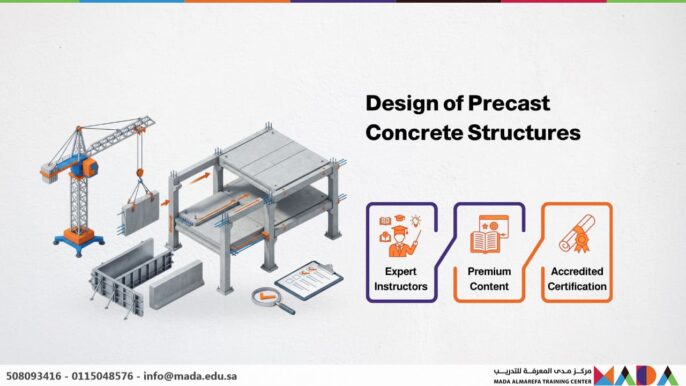
About the Course
The “Design of Precast Concrete Structures” course is a specialized program tailored to meet the rigorous demands of the 2026 construction and civil engineering sectors. As giga-projects expand globally and across the region, the shift toward off-site manufacturing and rapid on-site assembly has made precast expertise a strategic necessity. This course empowers engineers and technicians to master modern design concepts and implement global best practices in high-speed, high-quality structural execution.
Course Objectives
- Understand the fundamental structural principles of precast concrete systems.
- Apply technical specifications and safety standards (e.g., PCI and ACI) throughout the design phase.
- Utilize industry-standard software (e.g., ETABS, SAFE) for the analysis of precast elements.
- Master the preparation of detailed shop drawings and structural execution plans.
- Analyze diverse loading conditions, including gravity, wind, and seismic forces on precast systems.
- Implement advanced connectivity and joint design techniques between structural members.
- Make informed engineering decisions based on quality control, sustainability, and economic feasibility.
Course Syllabus
Day 1: Introduction to Precast Concrete Systems
- Core concepts: The logic of precast vs. cast-in-place concrete.
- Classifying precast elements: Slabs (Hollow-core, Double-T), Beams, Columns, and Wall Panels.
- Lifecycle of precast: Manufacturing, curing, transportation, and erection phases.
- Comparative Analysis: Speed, cost-efficiency, and quality control benefits.
Day 2: Structural Analysis of Precast Elements
Focusing on the unique behavior of segmented structures under load.
- Analyzing static and dynamic loads: Handling, shipping, and final service loads.
- Determining expected stresses, deflections, and deformations.
- Utilizing ETABS or SAFE for digital structural simulation.
- Evaluating design compliance with local building codes and international standards.
Day 3: Design of Primary Members (Beams, Columns, and Walls)
Designing for strength and serviceability where the moment capacity $M_n$ must satisfy:
$$M_u \leq \phi M_n$$
- Designing precast Beams under flexure and shear.
- Design of precast Columns: Managing axial loads and reinforcement detailing.
- Load-bearing Shear Walls: Stability and lateral resistance design.
- Selecting optimal cross-sections based on span-to-depth ratios and load requirements.
Day 4: Connections and Load Transfer Mechanisms
The most critical aspect of precast engineering: Ensuring the system acts as a monolithic whole.
- Types of connections: Dry Connections (Bolted/Welded) vs. Wet Connections (Cast-in-situ joints).
- Designing joint details for moment-resisting and pinned frameworks.
- Thermal effects and movement: Managing expansion, contraction, and creep in joints.
- Structural integrity: Ensuring overall system stability and progressive collapse resistance.
Day 5: Applied Case Studies and Practical Projects
- Technical analysis of a real-world precast project (Residential or Industrial).
- Capstone Project: Designing a comprehensive precast module using the principles learned.
- Presentation of results, peer review, and expert feedback sessions.
- Career Roadmap: Navigating job opportunities in the 2026 precast engineering market.

