
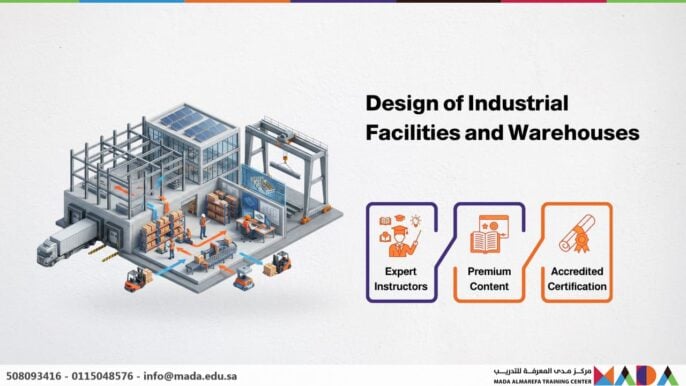
About the Course
The “Design of Industrial Facilities and Warehouses” course is a premier opportunity to master the latest methodologies and technologies used in the design and execution of large-scale industrial projects. This program addresses the 2026 labor market’s demand by providing integrated theoretical and practical content that elevates the expertise of engineers and technicians. It is the ideal choice for professionals seeking to specialize in the high-stakes field of industrial infrastructure and logistics hubs.
Course Objectives
- Understand the fundamental engineering principles governing industrial facilities and warehouse design.
- Apply international building codes and standards (e.g., ASCE, IBC) to industrial structures.
- Master the use of advanced engineering software for structural analysis and design.
- Implement rigorous Health, Safety, and Environment (HSE) protocols within industrial environments.
- Develop high-precision technical specifications tailored to specific project requirements.
- Identify and select optimal materials for industrial construction, including high-strength steel and specialized concrete.
- Evaluate the unique structural requirements for diverse industrial sectors (manufacturing, storage, cold chain).
Course Syllabus
Day 1: Introduction to Industrial Design and Facility Types
- Core concepts: Defining industrial facilities vs. commercial and residential structures.
- The strategic importance of industrial design in the evolving global and regional markets.
- Classification of industrial plants: Manufacturing hubs, distribution centers, and high-tech facilities.
- Review of primary challenges: Large spans, heavy loading, and functional flexibility.
Day 2: Structural Foundations of Industrial Projects
Focusing on the architectural and structural mechanics that define heavy-duty infrastructure.
- Essential structural elements: Frames, trusses, and Pre-Engineered Building (PEB) systems.
- Analyzing load types: Dead, Live, Crane, Wind, and Seismic loads.
- Material selection criteria for durability and cost-efficiency.
- Preliminary structural feasibility analysis and site assessment.
Day 3: Specialized Warehouse Design and Space Planning
Designing for efficiency: How floor and roof systems support modern logistics.
- Warehouse classification based on utility and storage technology.
- Safety requirements for high-density and hazardous material storage.
- Engineering design for heavy-duty industrial flooring (High-flatness and high-load slabs).
- Internal space planning: Optimizing workflows, clear heights, and loading docks.
Day 4: International Standards and Safety Compliance
- In-depth review of global standards: ASCE 7 and the International Building Code (IBC).
- Occupational health and safety integration in industrial design.
- Fire Safety Engineering: Suppression systems, egress routes, and fire-rated structures.
- Ensuring compliance with local building regulations and international environmental codes.
Day 5: Design Software and Analytical Tools
Utilizing 21st-century technology for high-precision structural simulation.
- Overview of industry-leading software for industrial drafting and BIM.
- Using AutoCAD for detailed technical layouts and preliminary drafting.
- Advanced structural analysis using SAP2000 and ETABS for complex industrial frames.
- Selection strategies: Choosing the right software based on project complexity and structural behavior.

