
Course Overview
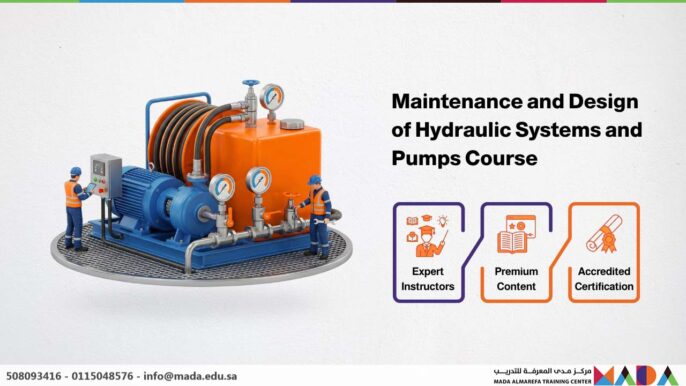
The Maintenance and Design of Hydraulic Systems and Pumps course is a specialized training program designed to equip participants with the essential theoretical knowledge to master the principles of hydraulic systems and industrial pump operation. This course is directly aligned with the critical needs of the industrial, energy, and heavy equipment sectors. Today, a deep understanding of maintenance and design fundamentals has become an urgent necessity for any technical or engineering professional looking to excel in these high-demand fields.
Course Objectives
- Understand the fundamental concepts of hydraulic systems and their diverse industrial applications.
- Identify various pump types and learn how to select the optimal unit based on specific project requirements.
- Acquire the theoretical skills necessary to analyze hydraulic system faults and oversee maintenance.
- Learn to design simple and medium-complexity hydraulic circuits using theoretical analytical tools.
- Develop the ability to read and interpret technical hydraulic schematics and break down individual components.
Course Curriculum
Day 1: Introduction to Hydraulic Systems
- The concept of hydraulic systems and their primary classifications.
- Core components of a hydraulic system: Fluids, reservoirs, and actuators.
- Understanding the relationship between Pressure and Flow.
- Industrial applications: From manufacturing to heavy machinery.
Day 2: Study of Industrial Pumps and Classifications
- Defining pumps and their primary categories: Dynamic versus Positive Displacement.
- The working principle of Gear, Vane, and Piston pumps.
- Factors influencing pump performance: Viscosity, temperature, and head.
- Selection criteria: Choosing the right pump for the right load.
Day 3: Hydraulic Circuit Design
- Steps for designing a functional, simple hydraulic circuit.
- Mastering standard engineering symbols in circuit drafting.
- Studying motion and load dynamics in hydraulic loops.
- Design examples for lifting (jacks) and thrusting (cylinders) applications.
Day 4: Maintenance of Hydraulic Systems
[Image showing signs of hydraulic cavitation and aeration damage on components]
- Identifying the most common failure modes in hydraulic systems.
- Theoretical diagnostic methods and troubleshooting techniques.
- Maintenance protocols for pumps, control valves, and fluid lines.
- The vital role of Preventive Maintenance and fluid filtration in extending system life.
Day 5: Case Studies and Application Analysis
- Reviewing real-world cases across various hydraulic system configurations.
- Analyzing performance bottlenecks and system pressure drops.
- The role of pumps in overall system efficiency and power density.
- Discussion of best practices in design, operation, and safe shutdown.
Conclusion
Mastering the “art of fluid power” is a cornerstone for professional excellence in modern engineering. This course bridges the gap between basic physics and industrial reality, providing participants with the clarity needed to manage high-performance hydraulic systems. Whether you are aiming for a career in heavy equipment maintenance or industrial plant design, this program provides the technical foundation needed to lead with expertise.

