
Overview
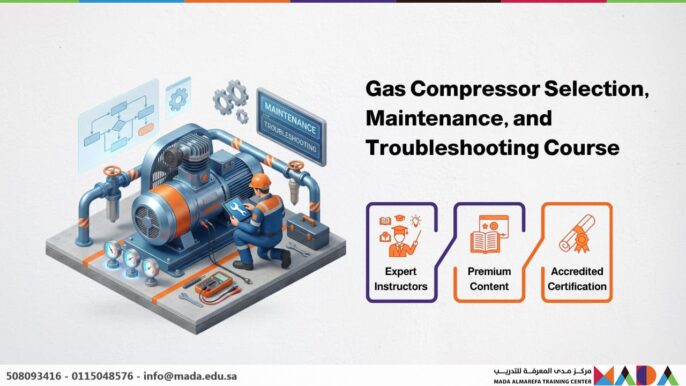
The Gas Compressor Selection, Maintenance, and Troubleshooting course is a specialized theoretical training program designed to establish a comprehensive understanding of the engineering and operational principles governing gas compressors in industrial environments. This includes critical sectors such as oil and gas, petrochemicals, and manufacturing.
The course aims to provide participants with solid theoretical knowledge regarding compressor types, their operational mechanisms, and the criteria for selecting them based on specific process requirements. Additionally, it covers preventive maintenance concepts and the identification of common faults and their causes through analytical methods.
The content is presented entirely in a theoretical format, without practical exercises, equipment usage, or laboratory activities. This makes it highly suitable for mechanical engineers, technicians, maintenance supervisors, and process engineers. The curriculum covers various compressor classifications, including Reciprocating, Centrifugal, Screw, and Rotary compressors, offering detailed explanations of their functions, applications, and operating requirements. It also highlights key performance factors such as pressure, capacity, efficiency, and temperature, alongside periodic maintenance principles and vibration analysis from a theoretical perspective.
General Objective
The primary goal of this program is to empower participants with an in-depth theoretical understanding of gas compressor structures and functions. Focus is placed on selecting the appropriate type based on gas characteristics, operating conditions, and performance requirements.
The program seeks to build the trainees’ ability to analyze system requirements and understand efficiency and reliability standards, as well as the role of maintenance in extending equipment life. It also emphasizes the importance of early fault detection and root cause analysis to minimize unplanned downtime. While the program does not require field maintenance experience, it presents concepts in a methodical way that supports informed technical decision-making during the design and operational phases.
Specific Objectives
- Understand the fundamental concepts of gas compressors, their main types, and their functions.
- Identify selection criteria based on gas type, required pressure, and capacity.
- Recognize the importance of preventive maintenance in sustaining high performance.
- Learn how to theoretically analyze common faults and determine their root causes.
- Understand the role of continuous monitoring in reducing sudden equipment failure.
Course Curriculum
Day 1: Introduction to Gas Compressors and Classifications
- Definition of compressors and their importance in gas transport and processing.
- Classification of compressors: Reciprocating, Centrifugal, Screw, and Rotary.
- Differences between Positive Displacement and Dynamic compressors.
- Applications for each type across various industrial sectors.
Day 2: Selection Criteria for Gas Compressors
- Factors influencing selection: Gas type, required pressure, capacity, and efficiency.
- Importance of analyzing gas characteristics (viscosity, corrosivity, impurities).
- The role of temperature and operating environment in determining the suitable type.
- Comparing initial capital costs versus long-term operational costs.
Day 3: Operating Principles and Efficiency
- Operational mechanisms of each compressor type from a theoretical perspective.
- Concepts of Volumetric, Mechanical, and Overall efficiency.
- The impact of internal leakage, friction, and pressure drops on performance.
- The balance between speed, pressure, and temperature.
Day 4: Preventive and Periodic Maintenance
- The concept of Preventive Maintenance (PM) for compressor systems.
- Periodic inspection steps: Oils, filters, seals, and connections.
- Theoretical importance of monitoring vibrations and temperatures.
- Documenting maintenance records and their role in performance optimization.
Day 5: Theoretical Troubleshooting and Fault Analysis
- Common faults: Overheating, leaks, excessive vibration, and loss of pressure.
- Root Cause Analysis (RCA) from a theoretical standpoint.
- Identifying whether a fault is mechanical, hydraulic, or electrical.
- The importance of technical reporting and corrective recommendations.
The Impact of the Course
This course is a vital element in building an advanced theoretical understanding of the mechanical systems used in gas processing and transport, particularly in high-density and sensitive industrial environments. It is of paramount importance for mechanical engineers, process engineers, and maintenance supervisors working in pumping stations, production platforms, and processing plants.
Furthermore, the course enhances the ability to evaluate compressor efficiency, understand performance challenges, and make technical decisions that reduce unplanned outages. In an industrial climate that relies on continuous operation and equipment reliability, understanding how to select, maintain, and diagnose compressors is essential for ensuring safety, reducing costs, and protecting capital investments.

