
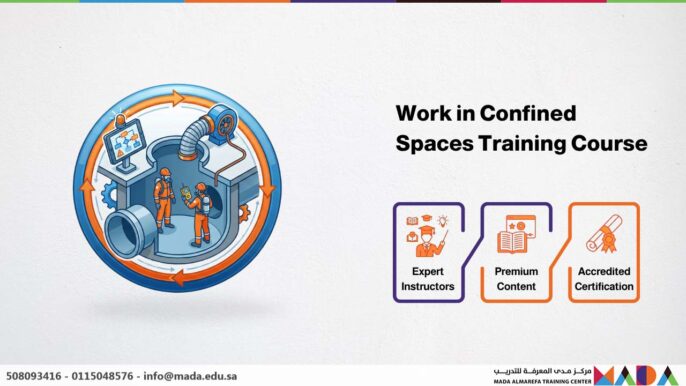
The Work in Confined Spaces course is a vital training program focused on the theoretical principles of ensuring safety and compliance while performing tasks in hazardous and restricted environments. This course is designed to provide participants with a comprehensive understanding of confined space concepts, types, and associated risks, in accordance with international occupational safety standards.
The program is strictly theoretical and does not include field activities or practical exercises. Instead, it offers precise knowledge regarding safe entry procedures, risk analysis, permit requirements, and the roles of support teams. It covers regulatory and preventive aspects that contribute to reducing accidents and protecting the health and safety of workers in industrial sectors such as factories, treatment plants, and distribution systems.
General Objective
The primary goal of the program is to empower trainees with advanced theoretical knowledge regarding the risks associated with entering closed or poorly ventilated environments. It seeks to develop the participants’ ability to identify confined space characteristics, analyze potential hazards—such as oxygen deficiency or the presence of toxic and flammable gases—and determine safe entry conditions. Furthermore, it prepares trainees to understand the roles of various team members (Supervisor, Entrant, Attendant), permit-to-work requirements, and emergency plans without the need for practical application.
Detailed Objectives
- Understand the definition and types of confined spaces within an industrial environment.
- Identify the health and environmental hazards associated with working in these spaces.
- Grasp the concept of risk analysis and conducting safety assessments prior to entry.
- Learn the conditions and procedures for safe entry into confined spaces.
- Develop a theoretical understanding of emergency plans and the role of rescue teams.
Course Curriculum
Day 1: Concepts and Types of Confined Spaces
- Defining a confined space according to international standards (e.g., OSHA).
- Examples of confined spaces: Tanks, tunnels, wells, and pipelines.
- The difference between confined spaces and open spaces regarding risk profiles.
- Classifying confined spaces based on the degree of hazard.
Day 2: Hazards Associated with Confined Spaces
This session analyzes the “silent killers” often found in restricted environments.
- Oxygen Deficiency: Causes and its impact on human health.
- Toxic Gases: Detailed look at Carbon Monoxide (CO) and Hydrogen Sulfide (H2S).
- Flammability: Risks of ignition due to the accumulation of flammable vapors.
- Physical Hazards: High temperatures, noise, and restricted movement.
Day 3: Safe Entry Procedures
- The importance of issuing a Permit to Work (PTW).
- Preparation steps: Isolation, ventilation, and atmospheric testing.
- The role and responsibilities of the Attendant (External Monitor).
- Communication protocols between entrants and support staff.
Day 4: Preventive Analysis and Safety Controls
- How to conduct a preliminary risk assessment (PRA).
- Utilizing gas detectors and interpreting internal environment data.
- Engineering and administrative controls to mitigate risks.
- The significance of theoretical qualification and training before any assignment.
Day 5: Emergency Plans and Incident Response
- Developing an emergency plan specific to confined space environments.
- Roles of rescue teams and conditions for intervention.
- Theoretical overview of rescue equipment: Tripods, harnesses, and Breathing Apparatus (SCBA).
- The importance of scenario-based theoretical training.
Conclusion and Professional Impact
The Work in Confined Spaces course is essential for industries involving maintenance, cleaning, or inspection within restricted environments. It is highly recommended for safety supervisors, occupational health and environmental engineers (HSE), maintenance technicians, and operations managers, particularly in the oil and gas, petrochemical, and water treatment sectors.
By completing this program, participants gain a thorough understanding of risk evaluation and informed decision-making, which reduces unplanned downtime and fosters a robust safety culture within the organization. In an era of strict global safety regulations, this course is a crucial step toward qualifying a workforce capable of protecting lives, ensuring legal compliance, and maintaining a sustainable and safe working environment.

