
General Overview
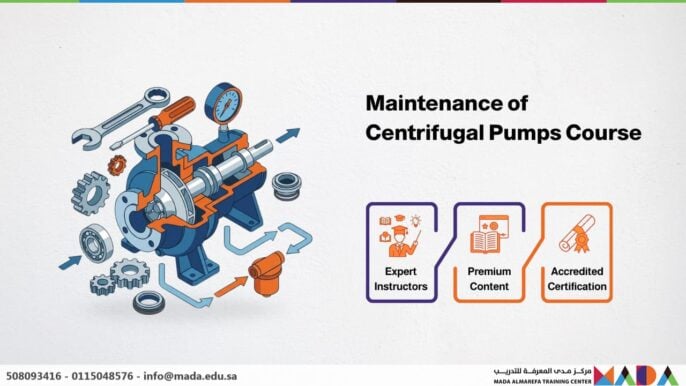
The Maintenance of Centrifugal Pumps course is a specialized training program designed to provide trainees with an in-depth theoretical understanding of the operating and maintenance principles of one of the most widely used pieces of equipment in industrial environments. This course offers comprehensive knowledge regarding core pump components, performance mechanisms, and theoretical fault diagnosis, focusing on cognitive understanding without relying on practical applications or field exercises.
The curriculum covers fundamental concepts such as the principle of centrifugal force, fluid pressure, and energy flow. It also explains common industrial challenges such as cavitation, vibrations, and shaft leaks. The content is delivered in a systematic and clear manner, enabling trainees to understand how to maintain pump efficiency, identify wear indicators, and make informed maintenance decisions based on the analysis of technical phenomena. This course is ideal for engineers, technicians, and operations supervisors in industrial sectors such as oil and gas, water treatment, and chemical industries.
General Objective
The primary goal of the program is to empower trainees with a precise theoretical understanding of the general framework for maintaining centrifugal pumps. The focus is on technical and analytical knowledge that contributes to improving operational efficiency and reducing downtime. The program seeks to consolidate the physical and engineering foundations of pump operation and how various components interact during service.
The general objective focuses on developing the trainees’ ability to understand the root causes of common failures, analyze performance indicators, and follow a structured methodology in troubleshooting. Furthermore, it introduces participants to the implementation of preventive maintenance programs and their role in extending equipment life and ensuring operational continuity. This program is a significant step toward building advanced technical awareness regarding the precision required in pump maintenance.
Detailed Objectives
- Understand the concept of centrifugal pump maintenance and its vital importance in industrial environments.
- Identify the primary components of the pump (Casing, Impeller, Shaft, and Seals).
- Comprehend the operating principles and factors affecting performance (Flow, Head, and Efficiency).
- Learn how to theoretically diagnose common faults such as cavitation, vibration, and leakage.
- Gain theoretical knowledge regarding preventive and corrective maintenance programs.
Course Outlines
Day 1: Introduction to Centrifugal Pumps
- Overview of the Maintenance of Centrifugal Pumps course and its industrial significance.
- Common applications of pumps across different sectors.
- The concept of centrifugal force and the conversion of kinetic energy into pressure.
- Classification of centrifugal pumps based on design and function.
Day 2: Core Components and Their Functions
- Explaining the Impeller and its types (Open, Closed, and Semi-closed).
- The role of the Casing (Volute) in directing fluid flow and increasing pressure.
- The Shaft and support media (Bearings).
- Types of shaft seals: Mechanical Seals versus Gland Packing.
Day 3: Performance Principles and Indicator Analysis
- Understanding the Performance Curve and its key elements.
- How changes in flow rate affect the head and overall efficiency.
- Theoretical insight into power requirements and efficiency coefficients.
- The importance of selecting the right pump based on specific system requirements.
Day 4: Common Faults and Diagnostic Methods
- In-depth explanation of Cavitation and its primary causes.
- Vibration analysis and its relationship to imbalance or misalignment.
- Theoretically diagnosing leaks from the shaft or joints.
- The impact of impurities and abrasive materials on internal components.
Day 5: Maintenance Programs and Extending Pump Life
- The concept of preventive maintenance and its role in reducing catastrophic failures.
- Periodic maintenance schedules: Inspection, lubrication, and visual checks.
- The role of logs and documentation in tracking pump health over time.
- The importance of continuous technical training on correct operational practices.
Conclusion
The Maintenance of Centrifugal Pumps course is a vital developmental tool for anyone working in operations and maintenance within industrial facilities, including water stations, factories, or the oil and gas sector. This course helps build a precise theoretical understanding of how pumps function, how to identify the causes of failure, and how to make calculated maintenance decisions that enhance operational efficiency and reduce repair costs.
These skills are essential for mechanical engineers, specialized technicians, and maintenance supervisors who deal with pumping systems daily. The course is also suitable for individuals seeking to enhance their technical skills or prepare for leadership roles within maintenance teams. Thanks to its organized theoretical approach, the course enables trainees to understand the operational complexities of this critical equipment, leading to decisions that reduce downtime and increase system reliability.

