
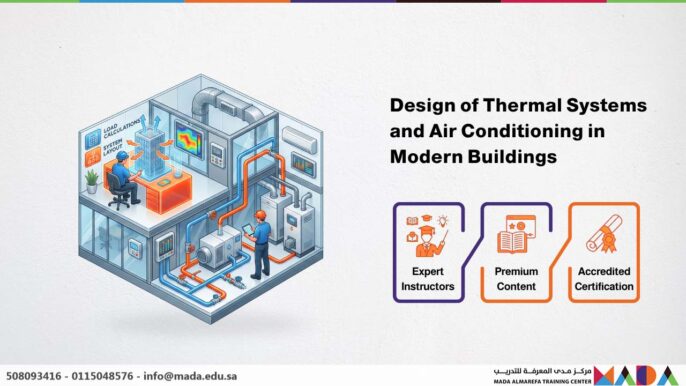
Course Overview
The Design of Thermal Systems and Air Conditioning in Modern Buildings course is a specialized program tailored to the needs of the mechanical engineering and energy sectors. It aims to equip participants with the essential theoretical skills required to understand and analyze cooling and air conditioning (HVAC) systems in contemporary urban projects. This course offers a unique opportunity to learn the latest methodologies used to design thermal systems with high effectiveness and optimal efficiency.
Course Objectives
- Understand the fundamental concepts of HVAC and thermal control systems.
- Analyze building thermal design requirements based on occupancy and usage types.
- Select appropriate equipment and hardware for refrigeration and air conditioning systems.
- Study technical specifications to enhance energy efficiency in thermal systems.
- Utilize industry-standard software to simulate and design HVAC systems.
- Apply safety and efficiency standards during the system design phase.
- Commit to environmental and sustainable standards when implementing air conditioning solutions.
Course Outline
Day 1: Introduction to Thermal Systems and Air Conditioning
- Core concepts in thermodynamics and fluid mechanics.
- Classification of air conditioning systems and their specific applications.
- Psychrometrics: The relationship between humidity and temperature in system design.
- Principles of heat transfer (conduction, convection, and radiation) in buildings.
Day 2: Building Thermal Load Analysis
- Identifying internal and external thermal load factors (Sensible and Latent heat).
- Methods for calculating thermal loads using standard engineering equations.
- The impact of thermal insulation on reducing energy consumption.
- Theoretical case study: Calculating the thermal load for a residential building.
Day 3: Central Air Conditioning System Design
- Types of central HVAC systems: Variable Air Volume (VAV) and Variable Refrigerant Flow (VRF).
- Fundamentals of air distribution duct design.
- Selection criteria for compressors and refrigeration cycles.
- Concepts of air distribution and zoning within various spaces.
Day 4: Energy Efficiency in Thermal Systems
- Reviewing international energy efficiency standards (such as ASHRAE).
- Energy-saving technologies and smart controls in HVAC systems.
- The role of thermal insulation and lighting in reducing overall heat load.
- Theoretical applications for optimizing performance in existing systems.
Day 5: Software Applications in System Design
- Introduction to Carrier Design Pro tools.
- Using HAP (Hourly Analysis Program) for comprehensive thermal analysis.
- Simulating an HVAC design for a specific structural model.
- Comparative study between different design options and equipment selection.

