
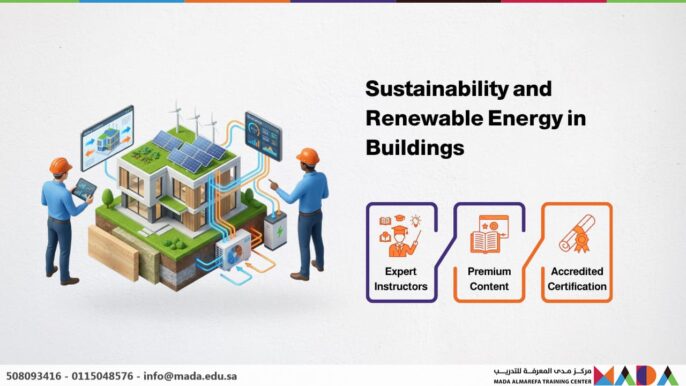
About the Course
The “Sustainability and Renewable Energy in Buildings” course is an ideal opportunity to understand the strategic importance of designing and operating structures with a focus on long-term viability. This program emphasizes reducing energy consumption and integrating clean sources—such as solar and wind energy—into the real estate sector. As the 2026 labor market shifts toward “Green Technology,” this course prepares qualified professionals to meet the rigorous demands of sustainable construction and eco-friendly infrastructure.
Course Objectives
- Understand the core concepts of sustainability and their practical application in building design and operations.
- Identify renewable energy sources (Solar, Wind, Geothermal) suitable for residential and commercial facilities.
- Study advanced techniques for energy reduction and resource efficiency.
- Master environmental assessment standards, including LEED and BREEAM.
- Develop skills in conducting economic feasibility studies for renewable energy integration.
- Familiarize yourself with global and local sustainability policies and frameworks.
- Enable participants to make informed decisions in the planning and design of net-zero projects.
Course Syllabus
Day 1: Foundational Concepts in Sustainability
- The triple bottom line: Environmental, Economic, and Social sustainability.
- The relationship between sustainable practices and the modern construction industry.
- Sustainability challenges: Smart Cities vs. traditional urban structures.
- The role of governments and international organizations in promoting green building.
Day 2: Introduction to Renewable Energy Systems
Analyzing the shift from traditional grids to decentralized clean energy.
- Renewable energy sources: Overview and categorization.
- Efficiency comparison: Conventional energy vs. Renewable energy systems.
- Practical applications of Solar PV and Wind energy in buildings.
- Technical and economic hurdles to widespread renewable adoption.
Day 3: Sustainable Building Design and Efficiency
Focusing on Passive Design to minimize mechanical energy reliance.
- Principles of “Green Design” and energy performance optimization.
- Selecting eco-friendly and low-carbon construction materials.
- The role of Daylighting and high-performance Thermal Insulation.
- Introduction to Energy Management Systems (EMS) in smart buildings.
Day 4: Environmental Rating and Certification Standards
- Deep dive into LEED (USA) and BREEAM (UK) rating systems.
- Technical requirements for achieving sustainability certifications in real estate.
- Case Study: Analysis of a LEED-certified project and its performance metrics.
- How certifications impact project market value and corporate reputation.
Day 5: The Future of Sustainability and Renewable Energy
- Emerging trends in 2026: Clean energy storage and AI-driven smart buildings.
- Global and national policies supporting the “Green Transition.”
- Career opportunities: Navigating the job market in sustainability and clean energy.
- Career Roadmap: How to start and scale your professional journey in this field.

