
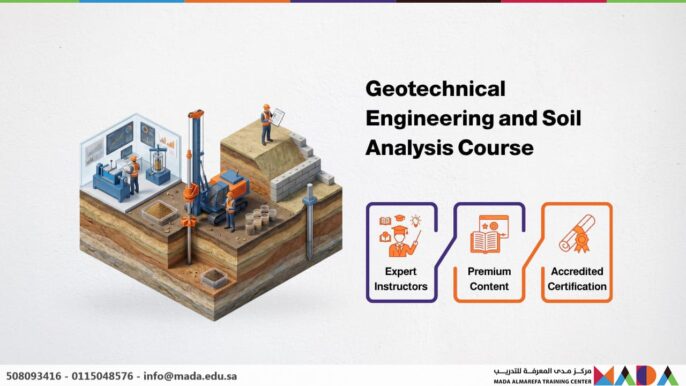
About the Course
The “Geotechnical Engineering and Soil Analysis” course is a specialized program designed to meet the rigorous demands of the 2026 construction and infrastructure sectors. It focuses on the fundamental understanding of soil behavior and the critical analytical techniques required before the execution of any civil project. Through this course, engineers and technicians will master the theoretical skills needed to predict geological responses and apply engineering principles to ensure structural stability from the ground up.
Course Objectives
- Understand the core concepts of geotechnical engineering and the mechanics of soil.
- Master soil classification methods and essential laboratory testing protocols.
- Identify diverse soil types and their specific impact on foundation design and settlement.
- Learn to evaluate soil stability under various static and dynamic loading conditions.
- Study advanced methodologies for improving the properties of weak or expansive soils.
- Develop high-level skills in interpreting laboratory geotechnical reports and borehole data.
- Enhance proficiency in using theoretical models to forecast soil performance and shear failure.
Course Syllabus
Day 1: Introduction to Geotechnical Engineering
- Core concepts: The strategic importance of geotechnics in the project lifecycle.
- The interaction between soil properties and infrastructure longevity.
- Soil classification according to the Unified Soil Classification System (USCS).
- Physical and chemical properties: Phase relationships, void ratios, and porosity.
Day 2: Essential Laboratory Soil Testing
Focusing on the empirical data that drives design decisions.
- Determination of natural moisture content and specific gravity ($G_s$).
- Atterberg Limits: Calculating Liquid Limit (LL), Plastic Limit (PL), and Shrinkage Limit (SL).
- Sieve Analysis: Grain size distribution and determining the coefficient of uniformity ($C_u$).
- Understanding the Plasticity Index ($PI$) and its role in soil behavior.
Day 3: Analysis of Soil Shear Strength and Consolidation
Mastering the Mohr-Coulomb Failure Criterion where shear strength $\tau$ is defined as:
$$\tau = c + \sigma \tan(\phi)$$
- Core concepts of shear strength: Cohesion ($c$) and the angle of internal friction ($\phi$).
- The Direct Shear Test: Methodology and data interpretation.
- The Unconfined Compression Test: Analyzing clay consistency.
- Connecting test results to safe bearing capacity and foundation design.
Day 4: Soil Compaction and Consistency Analysis
Optimizing soil density for stable construction bases.
- The physics of compaction: Cohesion vs. Internal friction in compacted fills.
- Standard and Modified Proctor Tests for determining Maximum Dry Density (MDD).
- The impact of Optimum Moisture Content (OMC) on structural stability.
- Evaluating soil saturation levels and their relationship to settlement.
Day 5: Soil Improvement and Practical Applications
- Theoretical concepts of soil stabilization and reinforcement.
- Using chemical additives (Lime, Cement) and Geosynthetics to improve weak strata.
- Soil-structure interaction: Impact on Shallow Foundation design.
- Theoretical Case Study: Analyzing geotechnical failures and successful remediation in past mega-projects.

