
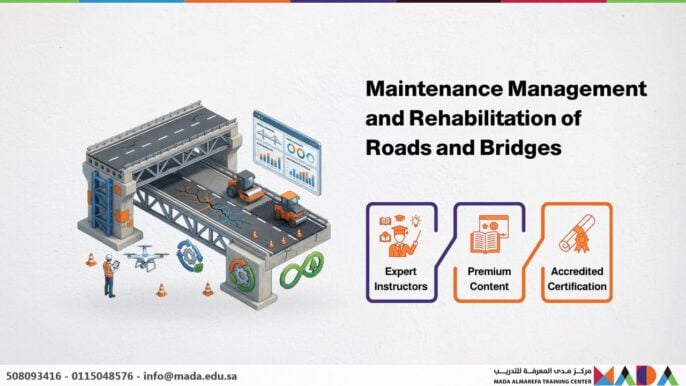
About the Course
The “Maintenance Management and Rehabilitation of Roads and Bridges” course is a vital program designed to meet the rigorous demands of the 2026 infrastructure sector. Offered by the Mada Al-Maarifa Training Center, this course focuses on developing the technical and managerial expertise required to oversee large-scale transport networks. By bridging the gap between field engineering and asset management, participants will master modern maintenance protocols that ensure project longevity and sustainable urban connectivity.
Course Objectives
- Understand the fundamental concepts of infrastructure maintenance and rehabilitation engineering.
- Acquire specialized skills in planning and executing large-scale maintenance operations efficiently.
- Master the use of modern diagnostic tools and technologies for technical condition assessment.
- Develop proficiency in resource allocation and cost management within rehabilitation projects.
- Enhance decision-making capabilities to address complex operational and structural challenges.
- Align local maintenance activities with international safety and quality standards.
- Apply global best practices in the structural rehabilitation of highways and bridges.
Course Syllabus
Day 1: Introduction to Infrastructure Maintenance Management
- The strategic role of maintenance and rehabilitation in the transport sector.
- Preventive vs. Corrective Maintenance: Cost-benefit analysis and risk profiles.
- Roles and core responsibilities of a Maintenance Manager in mega-projects.
- Case Study: Analyzing common failure patterns in regional road networks.
Day 2: Technical Condition Assessment (Roads & Bridges)
Focusing on Non-Destructive Testing (NDT) and Structural Health Monitoring (SHM).
- Modern survey methodologies: Utilizing LiDAR and automated distress detection.
- Technical inspection tools and NDT methods (Ultrasonic, Ground Penetrating Radar).
- Classifying bridge distress: Cracks, spalling, carbonation, and joint failures.
- Hands-on concepts of Pavement Management Systems (PMS).
Day 3: Strategic Planning and Maintenance Control
Optimizing workflows to minimize traffic disruption and maximize resource utility.
- Stages of strategic planning for multi-year maintenance projects.
- Developing dynamic schedules using Gantt Charts and the Critical Path Method.
- Managing human capital and material logistics in high-traffic maintenance zones.
- Case Study: Operational management of a major highway rehabilitation project.
Day 4: Cost Management and Economic Feasibility
Ensuring financial viability through ROI and Net Present Value (NPV) analysis.
- Precise cost estimation for rehabilitation vs. total reconstruction.
- Economic analysis: Comparing maintenance options based on Lifecycle Costs.
- Utilizing financial decision-support tools for infrastructure investments.
- Practical exercises: Calculating ROI and NPV for a bridge repair project.
Day 5: Sustainability, Quality, and Integrated Management
- Sustainable Maintenance: Eco-friendly materials and environmental impact reduction.
- Quality Assurance (QA) and Quality Control (QC) standards in execution.
- The role of local and international regulatory bodies (e.g., AASHTO, IBD).
- Final Project: Designing a comprehensive maintenance roadmap for a real-world infrastructure asset.

