
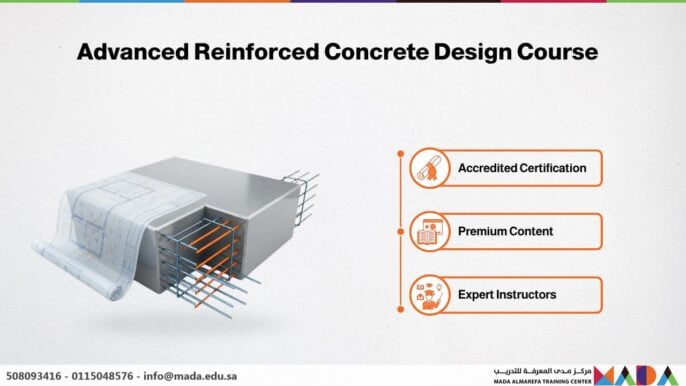
About the Course
The “Advanced Reinforced Concrete Design” course is a premier opportunity for engineers and construction professionals to elevate their skills in modern structural design. This course focuses on cutting-edge theoretical methods for designing reinforced concrete structures in full alignment with the 2026 labor market requirements and global industry standards, specifically the ACI 318 building code. Participants will gain a profound understanding of complex structural processes and master the high-precision analysis of structural elements.
Course Objectives
-
- Grasp advanced concepts in the design and behavior of reinforced concrete.
- Master the application of the American Concrete Institute code (ACI 318) for structural members.
- Achieve proficiency in designing columns, retaining walls, and various slab systems.
- Analyze structural elements under the influence of vertical (gravity) and horizontal (lateral) loads.
- Apply rigorous mathematical models for stress and strain calculations in concrete sections.
- Enhance the participant’s capability to make precise and safe design decisions.
- Develop advanced skills in interpreting and drafting complex structural blueprints.
Course Syllabus
Day 1: Fundamentals of Structural Design for Reinforced Concrete
- Review of reinforced concrete concepts and modern applications.
- In-depth analysis of material properties: Concrete strength and steel reinforcement grades.
- Principles of limit state design and safety factors based on various load combinations.
- Introduction to international building codes: ACI 318 and Eurocode 2.
Day 2: Design of Columns and Retaining Walls
- Classification of columns (short vs. slender) and methods of analysis.
- Calculating axial forces and the resulting bending moments ($M_u$).
- Structural design of reinforced concrete retaining walls.
- Study of soil-structure interaction and its impact on wall stability.
Day 3: Design of Slabs and Roof Systems
- Classification of slab systems: One-way, Two-way, Flat Slabs, and Ribbed Slabs.
- Load distribution mechanisms and tributary areas.
- Designing slabs using the Direct Design Method and Equivalent Frame Method.
- Calculating slab thickness for deflection control and reinforcement requirements.
Day 4: Design of Concrete Foundations
- Types of foundations: Isolated, Strip, Combined, and Raft (Mat) foundations.
- Determining optimal dimensions for concrete footings based on soil bearing capacity.
- Designing foundations under vertical loads and lateral moments.
- Reinforcement detailing and connectivity between structural elements.
Day 5: Analysis and Design Under Special Conditions
- Analyzing elements under the influence of thermal expansion and humidity.
- Introduction to Seismic Design and the impact of earthquakes on concrete structures.
- Design considerations for blast resistance and structural vibrations.
- Review of real-world case studies in advanced concrete element design.

