
About the Course
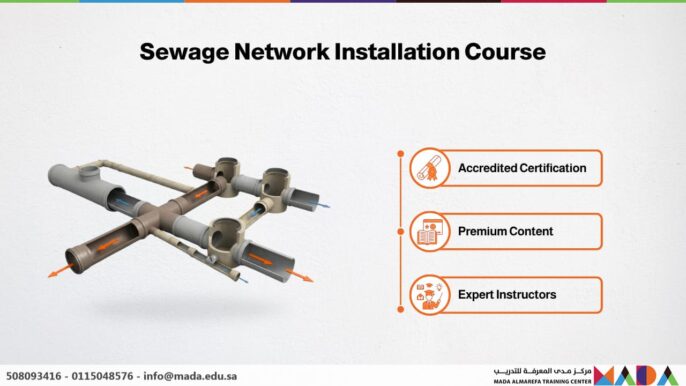
The Sewage Network Installation Course provides a specialized opportunity to master the fundamental and advanced skills required for the design and installation of sewage systems. This program is specifically designed to qualify technical personnel to meet the growing demands of the infrastructure labor market. Through this course, participants will master the theoretical concepts necessary to understand the mechanics of wastewater networks and apply them effectively across various engineering projects.
Course Objectives
-
- Understand the core principles of sewage network design and installation.
- Identify the materials and equipment essential for implementing wastewater systems.
- Acquire the professional skills needed to interpret engineering drawings and network maps.
- Learn how to determine appropriate network dimensions and scales based on specific project requirements.
- Study the environmental and health regulations associated with sewage planning.
- Identify common challenges in drainage systems and master preventive strategies.
- Develop the capacity to technically monitor and review sewage network projects.
Course Syllabus
Day 1: Introduction to Sewage Networks
- Core concepts and classifications of sewage networks.
- The vital role of wastewater systems in modern infrastructure.
- Components of a sewage system and their specific functions.
- General challenges in the management and operation of drainage networks.
Day 2: Sewage Network Design
- Engineering design principles for wastewater systems.
- Key factors in determining pipe diameters and hydraulic slopes.
- Utilizing specialized software for network line drafting.
- Technical feasibility studies for small and medium-sized projects.
Day 3: Materials and Equipment
- Types of pipes used in sewage networks (PVC, HDPE, Ductile Iron, etc.).
- The role of joints, manholes, and inspection chambers in the system.
- Classification of auxiliary tools and heavy equipment.
- Quality specifications and international standards for materials.
Day 4: Interpreting Engineering Drawings and Maps
- Interpreting topographic maps and integrating them with sewage systems.
- Decoding symbols and notations used in executive engineering drawings.
- Methods for defining axes and depths in the implementation plan.
- Practical case studies on sewage network drafting and layout.
Day 5: Operation and Theoretical Maintenance
- Concepts for the safe operation of drainage systems.
- Methods for preventive and corrective maintenance.
- Theoretical identification of common system faults and failures.
- Environmental and health guidelines for sustainable network operation.

