
About the Course
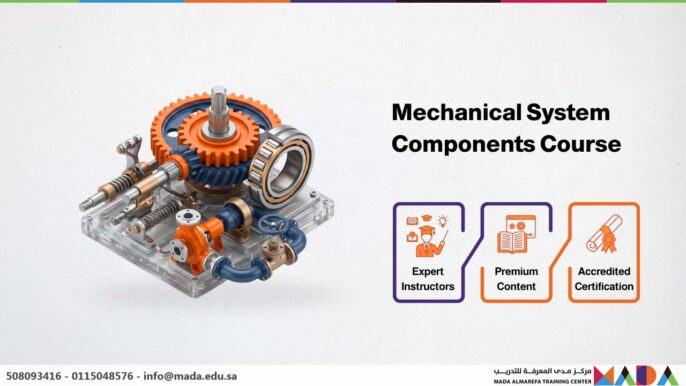
The Mechanical System Components Course offers a unique opportunity to master the fundamentals and intricate details of the equipment and essential parts used in industrial mechanical systems. This program is an integrated training solution designed to meet the technical demands of the mechanical engineering and industrial maintenance labor markets. It provides participants with a robust theoretical foundation, enabling them to understand how mechanical systems operate with maximum efficiency, precision, and reliability.
Course Objectives
- Understand the core concepts of various mechanical system components.
- Identify the primary functions of each component and how they interact within a system.
- Distinguish between different types of components and their diverse industrial applications.
- Acquire analytical skills to comprehend the structural design of mechanical systems.
- Master the precise use of technical terminology specific to mechanical engineering.
- Apply theoretical knowledge to enhance and optimize system performance.
- Prepare for advanced certifications and courses in the maintenance and operation of mechanical systems.
Course Curriculum
Day 1: Introduction to Mechanical Systems
- Overview of mechanical system concepts and their primary classifications.
- The strategic importance of mastering component fundamentals in industrial fields.
- Identifying the basic hardware common to all mechanical systems.
- The role of individual components in achieving overall operational efficiency.
Day 2: Core Hardware and Structural Components
- Static Components: Frames, housings, and structural supports.
- Dynamic Components: Shafts, gears, and rotating assemblies.
- An overview of manufacturing materials and their mechanical properties.
- Classifying components based on their specific utility and functional role.
Day 3: Power Transmission and Motion Systems
- Belt and Pulley Systems: Designs, tensioning, and industrial applications.
- Chain and Gear Systems: High-torque transmission and timing accuracy.
- Components responsible for converting motion (Rotary to Linear).
- Analyzing the synergy of components in efficient power transmission.
Day 4: Hydraulic and Pneumatic Components
- Air cylinders (Pneumatic) and fluid motors (Hydraulic).
- Control valves: Directional, pressure, and flow control functions.
- Tubing, hoses, and connectors for fluid and air transport.
- A technical comparison between hydraulic and pneumatic systems: Advantages and limitations.
Day 5: Review and Case Study Analysis
- Comprehensive review of critical mechanical components discussed.
- Systemic analysis: How individual parts function as a cohesive unit.
- Reviewing real-world design examples of complex mechanical systems.
- An overview of the latest technological trends in component design and smart materials.
Conclusion
In the modern industrial landscape, a deep understanding of mechanical components is the baseline for professional excellence. Whether you are aiming to design new systems or oversee the maintenance of existing ones, this course provides the structural knowledge required to ensure every part of the machine works in harmony. By mastering these theoretical principles, participants gain the confidence to lead technical teams and drive innovation in the mechanical engineering sector.

