
General Overview
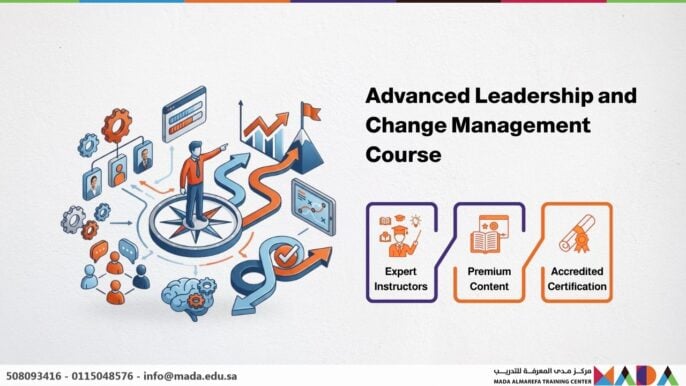
The Advanced Leadership and Change Management Course is a strategic training program designed to qualify leaders and managers to understand the complex challenges associated with implementing organizational transformations in modern institutions. This course is structured to provide deep theoretical knowledge of advanced change management principles, focusing on leadership aspects, individual behavior, and institutional transformation mechanisms, without the need for practical applications or field exercises.
The course covers globally recognized change models, such as Kotter’s 8-Step Process and Lewin’s Change Management Model, alongside explaining the psychological and organizational challenges teams face during transitional periods. The content is presented in an analytical and methodical manner, enabling trainees to lead change with confidence, engage stakeholders, and build a resilient corporate culture capable of adapting to future challenges. This course is ideal for executive leaders, department managers, and organizational transformation supervisors in both government and private sectors.
General Objective
The primary goal of the Advanced Leadership and Change Management program is to empower participants with an advanced theoretical understanding of how to lead organizational transformations effectively and professionally. The program seeks to consolidate knowledge of the foundations upon which successful change processes are built, starting from strategic planning, through team engagement, and ending with embedding change as part of the organizational culture.
The general objective focuses on developing the trainees’ ability to analyze resistance to change, understand the dynamics of organizational behavior, and make informed leadership decisions that contribute to minimizing disruptions and achieving transformational goals. It also aims to introduce participants to building change-supportive teams, employing strategic communication tools, and evaluating the impact of transformations on institutional performance.
Detailed Objectives
- Understand the concept of advanced leadership and change management and its significance in the contemporary business environment.
- Identify theoretical change management models and the mechanisms for their application within organizations.
- Recognize the sources of resistance to change and how to overcome them through effective leadership.
- Learn how to design a strategic change plan that considers the organizational and cultural context.
- Gain theoretical knowledge on measuring the impact of change and ensuring its long-term sustainability.
Course Modules
Day 1: Advanced Introduction to Change Management
- Introduction to the “Advanced Leadership and Change Management” course.
- Why do most organizational change initiatives fail?
- The difference between administrative change and strategic change.
- An overview of contemporary challenges in leading transformations.
Day 2: Globally Recognized Change Models
- Detailed explanation of Kotter’s Eight-Step Model for successful transformation.
- The ADKAR model concept and its relationship to individual behavior.
- A theoretical look at Lewin’s Model (Unfreeze, Change, Refreeze).
- How to choose the appropriate model based on the nature of the organization.
Day 3: Change Leadership and the Leader’s Role
- The concept of transformational leadership during periods of transition.
- How to build a compelling and motivating vision for change.
- The leader’s role in reducing skepticism and building trust.
- The importance of continuous leadership presence throughout the stages of change.
Day 4: Stakeholder Engagement and Decision Making
- Identifying influential stakeholders in the change process.
- Analyzing stakeholder impact and their stance on the transformation.
- Strategic communication methods with teams and departments.
- The role of transparency in reducing resistance to change.
Day 5: Sustainability of Change and Impact Measurement
- The concept of anchoring change within the organizational culture.
- How to measure the success of a change initiative using Key Performance Indicators (KPIs).
- The importance of feedback and its role in continuous improvement.
- Mechanisms for review and development post-change implementation.
Target Audience and Conclusion
The Advanced Leadership and Change Management Course is a vital strategic tool for anyone holding leadership or supervisory positions in organizations undergoing transformation or seeking organizational excellence. This course contributes to building deep leadership awareness on managing change-related challenges, motivating teams, and achieving sustainable transformation.
These skills are essential for executive managers, institutional development officers, and HR managers responsible for guiding transformation paths. The course is also suitable for individuals planning to implement major change initiatives such as digital transformation, departmental restructuring, or cultural development. With its theoretical and methodical nature, the course establishes a strong knowledge base that enables trainees to understand the leadership and behavioral complexities of change management, leading to informed decisions that enhance organizational success in a dynamic and ever-changing business environment.

