
Course Overview
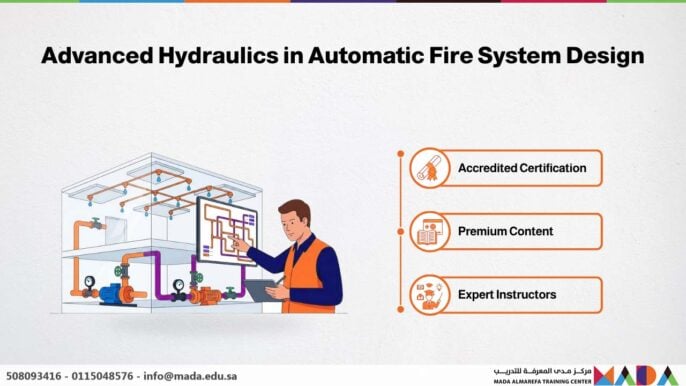
The Advanced Hydraulics in Automatic Fire System Design course is a specialized program tailored to the rigorous demands of the safety and civil defense sectors. This course provides deep theoretical knowledge essential for understanding and analyzing the hydraulic systems used in automatic fire suppression. By mastering these principles, engineers and technicians can develop highly effective, reliable, and compliant fire protection solutions that save lives and protect assets.
Learning Objectives
- Understand fundamental and advanced hydraulic principles specifically applied to fire protection.
- Analyze and design automatic fire suppression systems in accordance with international standards.
- Utilize mathematical equations and technical criteria to evaluate hydraulic system performance.
- Identify and select appropriate pumps, piping, and valves used in fire protection networks.
- Study theoretical cases to optimize the efficiency of automatic sprinkler systems.
- Evaluate pressures and flow rates in water networks to identify structural strengths and weaknesses.
- Apply best practices for selecting the right equipment for hydraulic fire systems.
Course Outline
Day 1: Fundamental Principles of Hydrodynamics
The foundation of any fire system lies in the physics of water movement. Day one covers the core behavior of fluids under pressure.
- Core concepts in Hydrodynamics.
- Fluid properties: Viscosity, density, and their practical implications.
- The relationship between pressure and flow rate in water systems.
- Friction effects and energy losses within pipelines (Hazen-Williams vs. Darcy-Weisbach).
Day 2: Automatic Fire Suppression System Design
Moving from theory to structure, we examine the physical components and the regulatory frameworks that govern them.
- Components of an automatic system: Valves, pumps, and sprinklers.
- System classification based on hazard level and occupancy.
- Design requirements according to local and international standards (e.g., NFPA 13).
- Determining water flow requirements and operational pressure benchmarks.
Day 3: Hydraulic Performance Analysis
This session focuses on the “math” behind the safety, ensuring the system performs when it matters most.
- Methods for calculating water pressure and flow in complex networks.
- Utilizing technical tables and software tools for hydraulic analysis.
- The impact of building height and elevation on system performance.
- Balancing system capacity with operational efficiency.
Day 4: Equipment Selection and Technical Specifications
Choosing the right hardware is critical. We dive into the machinery that powers fire protection.
- Criteria for selecting Main, Standby, and Jockey pumps.
- Valve types and their specific functions in flow regulation.
- Sizing pipes based on flow velocity and allowable pressure drops.
- Technical recommendations for the distribution and spacing of sprinklers.
Day 5: Case Studies and Practical Design Review
Finalizing the course by applying knowledge to real-world scenarios and avoiding common pitfalls.
- Theoretical analysis of sprinkler systems in commercial high-rises.
- Case studies of fire suppression systems in industrial facilities.
- Reviewing past designs to identify and correct common engineering errors.
- Discussion on technical challenges and strategic problem-solving.

