
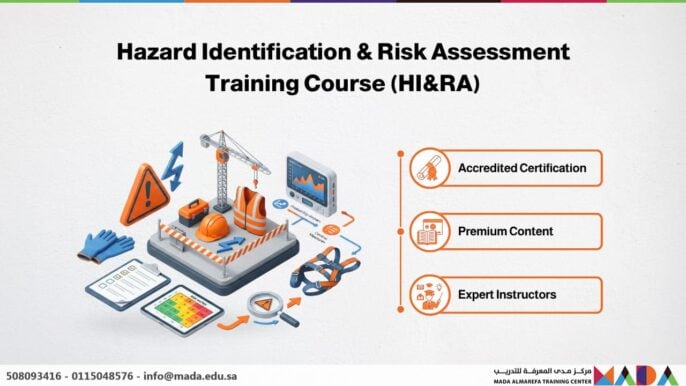
Course Overview
The Hazard Identification & Risk Assessment (HI&RA) course is an advanced theoretical training program designed to empower participants with the mechanisms for identifying and analyzing hazards before operational activities begin. This course focuses on building the capacity of trainees to pinpoint hazard sources, evaluate the probability and impact of occurrences, and establish effective preventive controls to ensure a safe and stable work environment. The content is specifically tailored for agricultural and industrial settings—such as production lines, cold storage facilities, and raw material warehouses—making it ideal for engineers, supervisors, and safety officers who require high-level theoretical knowledge without the need for field applications.
Target Audience
This course is specifically designed for professionals seeking to enhance their risk management capabilities, including:
- Occupational safety supervisors and experts in agricultural and industrial plants.
- Engineers and technicians working in production or maintenance.
- Quality control and industrial inspection officers.
- Operations and production managers.
- Students and researchers in the fields of agricultural engineering and occupational safety.
Course Curriculum
The curriculum is delivered over three intensive days, structured as follows:
Day 1: Hazard Identification and Types
- Defining the concepts of “Hazard” and “Occupational Risk.”
- Categories of hazards: Physical, Chemical, Biological, and Mechanical.
- Common hazard sources in agricultural and industrial work environments.
- Tools and techniques for hazard identification: Observation, Checklists, and Task Analysis.
- Practical applications: Examples from production lines and agricultural warehouses.
Day 2: Risk Assessment and Establishing Controls
- The four steps of risk assessment: Identification, Analysis, Evaluation, and Control.
- Utilizing the Risk Assessment Matrix to determine risk levels.
- Establishing Engineering and Administrative controls to mitigate risks.
- Integrating assessment results into the facility’s general safety plans.
- Hypothetical case study: Applying risk assessment to a production or storage process.
Day 3: Developing Safety Culture and Continuous Improvement
- The importance of safety culture in sustaining a secure work environment.
- The role of leadership and management in supporting risk assessment programs.
- The concept of “Continuous Improvement” in occupational safety systems.
- Preparing risk assessment reports and documenting preventive measures.
- Comprehensive review of the theoretical concepts acquired throughout the course.
Learning Objectives
By the end of this course, participants will be able to:
- Accurately recognize types and sources of hazards in the workplace.
- Master risk assessment steps in accordance with international standards.
- Design effective preventive plans prior to the start of operations.
- Promote a culture of safety and preventive awareness among the workforce.
Course Impact
On the Trainee
- Increased proficiency in analyzing and accurately assessing risks.
- Enhanced preventive decision-making skills in high-pressure environments.
- Greater career advancement opportunities in Occupational Health and Safety (OHS) fields.
On the Organization
- Reduced rates of workplace accidents and injuries.
- Strengthened compliance with international safety standards and regulations.
- Improved operational performance and guaranteed continuity of safe production.
The HI&RA course is an essential step for any organization striving to develop a functional and sustainable safety system. Through the theoretical knowledge gained, trainees will be equipped to analyze risks, design preventive strategies, and contribute to a safer, more efficient workplace.

