
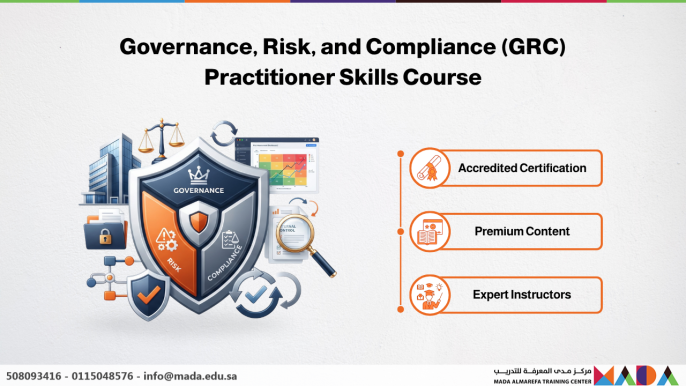
The Governance, Risk, and Compliance (GRC) Practitioner Skills Course provides a solid foundation for understanding an integrated GRC approach and translating it into policies and processes that support decision-making, integrity, and business sustainability. You will explore the role of governance in setting strategic direction, risk management in protecting value, and compliance in ensuring adherence to regulations and standards. This program focuses on building a practical, actionable framework tailored to your organization—from defining risk appetite and designing internal controls to measuring performance and reporting to executive management and board committees.
Target Audience
This course is designed for professionals currently working in or aspiring to enter the GRC ecosystem, including:
- Governance, risk management, and compliance officers.
- Internal audit, quality assurance, and performance management professionals.
- Department heads, business unit managers, and corporate transformation leaders.
- Legal, privacy, and data protection officers.
- Members and secretaries of corporate audit and risk committees.
- Professionals seeking to build a career and develop practical skills in Governance, Risk, and Compliance (GRC).
Course Modules
The curriculum is structured across five days to cover core concepts, practical application, and enterprise program development:
Day 1: Integrated Introduction to GRC and Integrity Culture
- Defining GRC as an integrated ecosystem rather than siloed functions, and identifying stakeholder roles.
- Corporate governance principles, accountability, and transparency, and aligning them with strategic objectives.
- Integrity culture, ethical conduct, and corporate values frameworks.
- Governance policies: committee charters, delegation of authority, and conflict of interest management.
Day 2: Enterprise Risk Management (ERM)
- Context establishment, risk appetite frameworks, and risk tolerance matrices.
- Risk management lifecycle: identification, assessment, treatment, monitoring, and communication.
- Risk registers, heat maps, and linking risks to controls and response plans.
- Business continuity and crisis management as extensions of risk management.
Day 3: Compliance and Internal Control
- Compliance obligations mapping: regulatory requirements, industry standards, and internal policies.
- Designing compliance controls, due diligence procedures, and whistleblowing channels.
- Internal control frameworks, the Three Lines Model, and the role of internal audit.
- Privacy and data protection management from a corporate compliance perspective.
Day 4: Operational Integration and Performance Measurement
- Process standardization: connecting policies to procedures, controls, and reporting.
- Key Performance Indicators (KPIs), Key Risk Indicators (KRIs), dashboards, and management/board reporting.
- Document and records management and the control lifecycle.
- Automation, GRC technology solutions, and data governance requirements.
Day 5: Building a GRC Program and Implementation Roadmap
- Maturity assessment, gap analysis, and developing a phased implementation roadmap.
- Organizational change management, communication, and stakeholder engagement frameworks.
- Case studies for extracting lessons learned and embedding best practices.
- Practical simulation: preparing an executive reporting package for the board and risk committees.
Learning Objectives
By the end of this course, you will be equipped to design and operate an integrated GRC program, enabling you to:
- Understand the interrelationship between governance, risk management, and compliance and align them with organizational strategy.
- Define risk appetite and develop effective risk registers and assessment matrices.
- Design practical compliance controls and policies that enforce adherence and mitigate risks.
- Establish KPIs and KRIs and prepare clear, actionable reports for executive management and board committees.
- Develop a GRC implementation and maturity roadmap and measure its impact on organizational performance.
- Apply international best practices and standards related to GRC within your workplace.
Course Impact
For the Participant
- Develop an integrated management perspective that connects policies directly to risks and controls.
- Enhance analytical capabilities and evidence-based, metric-driven decision-making.
- Accelerate career advancement and readiness for leadership roles in GRC.
For the Organization
- Increase control efficiency while reducing operational conflicts, legal exposure, and compliance gaps.
- Improve reporting quality and transparency for executive leadership, shareholders, and regulatory bodies.
- Foster a culture of compliance and integrity that strengthens corporate reputation and long-term sustainability.
The Governance, Risk, and Compliance (GRC) Practitioner Skills Course empowers you to transform GRC from a reactive compliance exercise into a proactive governance system that drives strategic achievement, mitigates risks, and ensures regulatory adherence. Upon completing the program, you will be prepared to establish a realistic GRC implementation roadmap and measure its tangible impact on corporate performance.

