
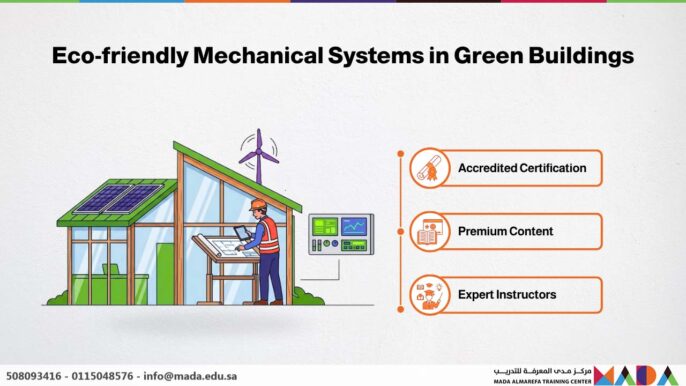
Course Overview
The Eco-friendly Mechanical Systems in Green Buildings course is a premier opportunity for professionals in engineering, energy, and construction to advance their technical expertise in sustainable design. This program focuses on modern practices that drastically reduce energy consumption and optimize the environmental performance of buildings. As global demand for sustainability experts reaches an all-time high, this course provides the theoretical framework needed to design and manage mechanical systems that are both energy-efficient and environmentally responsible.
Course Objectives
- Understand the fundamental concepts of green building and eco-friendly mechanical system design.
- Identify international standards for energy-saving HVAC (Heating, Ventilation, and Air Conditioning) systems.
- Study the design and operation of water recycling systems and sustainable water management.
- Analyze smart lighting technologies and their role in reducing a building’s carbon footprint.
- Evaluate materials and equipment for green projects based on efficiency and environmental impact.
- Master environmental performance assessment tools, such as LEED.
- Apply best practices in planning and executing eco-friendly mechanical infrastructures.
Course Outline
Day 1: Introduction to Green Buildings and Eco-Mechanical Systems
- The concept of Green Buildings and the pillars of sustainability.
- The strategic role of mechanical systems in achieving environmental efficiency.
- Analyzing environmental challenges within the global construction and energy sectors.
- Overview of international green building standards (e.g., LEED and BREEAM).
Day 2: Energy-Efficient Cooling and Heating Systems
- High-efficiency HVAC system design and optimization.
- Principles of Geothermal Cooling and ground-source heat pumps.
- Integrating solar thermal energy into building heating systems.
- Comparative analysis: Traditional vs. Eco-friendly mechanical systems.
[Image of ground-source geothermal HVAC system diagram]
Day 3: Water Management and Sustainability in Green Buildings
- The concept of Graywater Recycling and its industrial applications.
- Designing rainwater harvesting and utilization systems.
- Reducing water waste through smart, sensor-based distribution systems.
- The impact of advanced water systems on a building’s internal environment and humidity control.
Day 4: Smart Lighting and Energy Optimization
- Energy-saving lighting technologies (LED, T5, and beyond).
- Designing smart lighting systems based on occupancy sensors and daylight harvesting.
- Integrating lighting controls with Building Management Systems (BMS).
- Analyzing the impact of lighting efficiency on total building energy consumption.
Day 5: Global Assessment and Rating Systems
- Deep dive into LEED criteria and the weight of mechanical systems in certification.
- Classifying green buildings based on location, occupancy, and usage.
- Tools and software for evaluating the environmental performance of mechanical systems.
- Case Study: Comprehensive analysis of the mechanical infrastructure in a certified green building.

