
Course Overview:
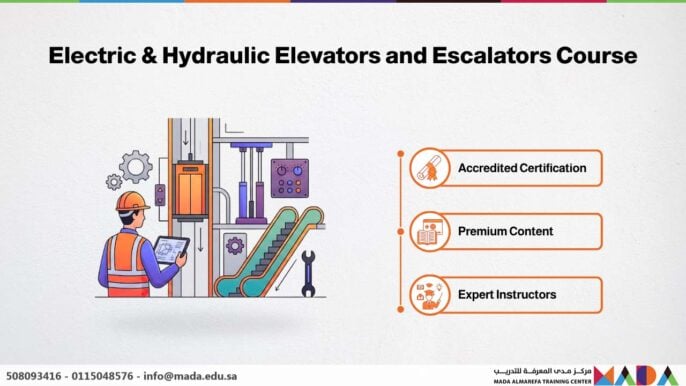
The Electric & Hydraulic Elevators and Escalators course is a specialized program designed to meet the growing demands of the labor market in the maintenance and operation of vertical transportation systems. This course provides participants with a comprehensive understanding of the components and operating systems for various types of elevators and escalators.
Course Objectives
By the end of this course, participants will be able to:
- Understand the technical foundations of electric and hydraulic elevator systems and escalators.
- Identify the electrical and mechanical components of each elevator type.
- Study the theoretical principles of operation and maintenance for vertical transport systems.
- Recognize safety and security standards essential for these systems.
- Analyze common elevator faults theoretically and learn how to address them.
- Gain familiarity with local and international standard specifications (ISO, EN, BS).
- Acquire organizational skills to manage elevator installation and operation projects.
Course Outline
Day 1: General Introduction to Vertical Transportation Systems
- Definition of electric elevators, hydraulic elevators, and escalators.
- History and evolution of vertical transport and its role in modern architecture.
- Classification of elevators based on usage and technology.
- The importance of specialized elevator training in today’s job market.
Day 2: Core Components of Electric Elevators
- In-depth look at the electrical system configuration.
- Understanding motors and electronic controllers (PLCs/Inverters).
- Counterweight systems, ropes, and wiring.
- Safety mechanisms and protection concepts in electric systems.
Day 3: Core Components of Hydraulic Elevators
- Understanding hydraulic pressure systems and their mechanism of action.
- Identifying oil pumps, piping, and hydraulic cylinders.
- Comparative analysis: Electric vs. Hydraulic elevators (Performance & Efficiency).
- Criteria for selecting the appropriate system based on building requirements.
Day 4: Escalators and Operation Technologies
- Anatomy of an escalator: Motors, steps, handrails, and drive chains.
- Operational mechanisms and motion control.
- Safety requirements for escalator design and installation.
- Practical applications in malls, airports, and major commercial centers.
Day 5: Theoretical Maintenance and Quality Standards
- Concepts of Preventive vs. Corrective Maintenance.
- International standard specifications for elevator systems (ISO, EN, BS).
- Theoretical analysis of common malfunctions and root causes.
- The roles of engineers and technicians in managing installation and operation projects.

