
General Overview
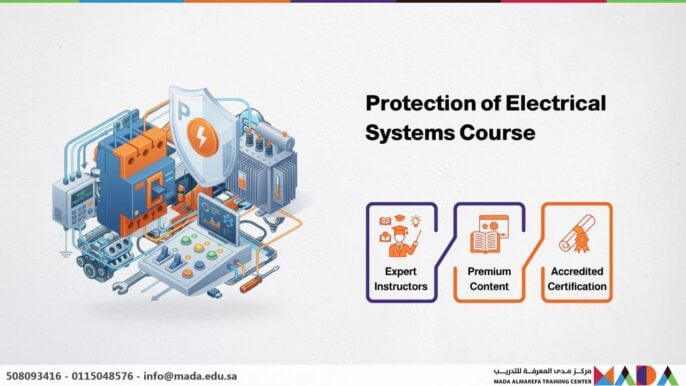
The Protection of Electrical Systems course is a specialized training program designed to deepen the theoretical understanding of protection systems within electrical circuits and networks. It focuses on the engineering and functional principles used to detect and isolate faults. This course provides comprehensive knowledge regarding protection system components, such as Relays and Circuit Breakers, and covers common fault types including short circuits, overcurrent, and unbalanced phases. Delivered as a purely theoretical framework, it does not include practical exercises or field applications.
The curriculum covers essential aspects such as protection coordination, the classification of systems by function (Current, Voltage, and Frequency protection), and their role in ensuring operational continuity and the safety of both equipment and personnel. The content is presented in a systematic and clear manner, enabling trainees to understand how to design effective protection schemes, analyze system behavior during emergencies, and make decisions based on precise technical insights. This course is ideal for electrical engineers, operations supervisors, and network planners in the power, industrial, and infrastructure sectors.
General Objective
The Protection of Electrical Systems program aims to provide trainees with an advanced theoretical understanding of the engineering and operational framework of electrical circuit protection. The focus is on ensuring operational safety, protecting assets, and improving network stability. The program seeks to consolidate knowledge of the foundations of protection systems, such as the principles of detecting current or voltage deviations, isolation speed, and the accuracy of “selectivity” between actual faults and normal operating conditions.
The general objective focuses on developing the trainees’ ability to understand how protection elements integrate within a network, the role of each component in preventing fault escalation, and maintaining power supply continuity. Furthermore, it introduces participants to analyzing protection system performance, understanding coordination requirements between different relays, and the role of international standards (such as IEEE and IEC) in guiding design. This program is a pivotal step toward building comprehensive technical awareness of protection in electrical systems.
Detailed Objectives
- Understand the concept of electrical system protection and its importance in ensuring the safety of equipment and operators.
- Identify common fault types in electrical circuits (Short Circuit, Overcurrent, Unbalanced Loads).
- Comprehend the functions of core protection elements: Relays, Circuit Breakers, and Current Transformers.
- Learn the principle of Protection Coordination and its relationship to effective isolation.
- Gain theoretical knowledge regarding the classification of protection systems based on function and application.
Course Outlines
Day 1: Introduction to Electrical System Protection
- Overview of the Protection of Electrical Systems course and its industrial significance.
- The concept of electrical protection and its goals (Safety, Continuity, Asset Protection).
- General look at system components: Source, Load, and Circuits.
- The importance of protective design in mitigating fault risks.
Day 2: Types of Faults in Electrical Systems
- Explaining Short Circuit faults and their types (Three-phase, Phase-to-Phase, Ground faults).
- The concept of Overcurrent and its primary causes.
- An overview of Unbalanced Loads and their impact on system performance.
- How voltage dips or surges affect system stability.
Day 3: Elements of Protection Systems
- The concept of Relays and their classifications (Electromechanical vs. Digital).
- The role of Circuit Breakers in fault isolation.
- Explaining the functions of Current Transformers (CTs) and Voltage Transformers (VTs).
- The importance of component accuracy in fault sensing and response speed.
Day 4: Principles of Protection System Design
- The concept of Protection Coordination and how it is achieved.
- Explanation of Time-Current Curves and their theoretical application.
- The importance of Selectivity between different protection levels.
- An overview of Backup Protection and its vital role in system reliability.
Day 5: Advanced Protection Systems and Applications
- Utilization of protection systems in Substations.
- Theoretical insight into Digital Protection and SCADA systems for monitoring.
- The role of protection in renewable energy systems (Solar and Wind).
- The influence of international standards (IEC, IEEE) on protection system design.
Conclusion
The Protection of Electrical Systems course is a vital analytical and design tool for anyone working in electrical engineering, network operations, or industrial facility management. This course contributes to building a strategic and technical understanding of how to design effective protection systems that minimize damage, ensure continuity, and protect lives and equipment.
These skills are essential for electrical engineers, operations supervisors, safety inspectors, and network planners in both the public and private sectors. The course is also suitable for those seeking to enhance their skills in electrical safety or prepare for roles requiring a precise understanding of preventive systems. Thanks to its organized theoretical approach, the course builds a robust knowledge base that enables trainees to navigate technical complexities and make informed decisions that enhance performance efficiency and operational safety.

