
General Overview
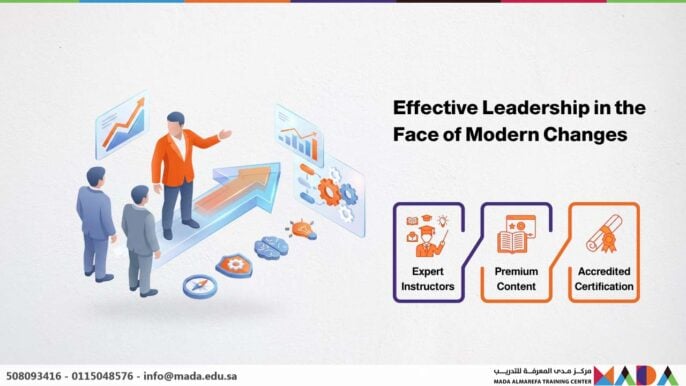
The Effective Leadership in the Face of Modern Changes course is a contemporary training program focused on developing an advanced theoretical understanding of leadership in the digital era and amidst rapid shifts in the work environment. This course is designed to provide participants with a comprehensive vision of how leaders can adapt to the technical, social, and organizational changes currently sweeping through institutions—such as Artificial Intelligence, remote work, team diversity, and the demand for rapid decision-making.
This course focuses on conceptual explanation and analytical study of contemporary leadership styles, the leader’s role in managing transformations, and building organizational resilience. It does not include practical exercises or field activities; instead, it is delivered in a way that empowers managers and leaders to understand modern challenges, anticipate the future, and make informed leadership decisions that contribute to sustainable institutional performance.
[Image comparing traditional leadership vs modern digital leadership styles]
General Objective
The primary goal of this program is to enable participants to acquire a deep theoretical understanding of leadership styles that align with the reality of modern institutions, where technology, business models, and employee needs change rapidly. The program seeks to build the trainees’ capacity for strategic thinking and understanding the impact of digital and cultural shifts on organizational performance, while developing flexible leadership skills necessary to manage diverse and geographically dispersed teams.
Detailed Objectives
- Understand the nature of modern variables affecting the work environment and leadership.
- Familiarize participants with the concepts of Digital Leadership and Remote Leadership.
- Recognize the importance of organizational resilience and Emotional Intelligence in modern leadership.
- Learn how to make effective leadership decisions under conditions of uncertainty.
- Develop a theoretical understanding of the leader’s role in building a culture of adaptation and innovation.
Course Curriculum
Day 1: Leadership Challenges in the Modern Era
- The impact of digital transformation on leadership styles.
- Challenges of managing remote and hybrid teams.
- The impact of social and cultural changes on the work environment.
- How the concept of leadership has evolved alongside employee expectations.
Day 2: Digital Leadership and the Smart Work Environment
- The concept of Digital Leadership and its importance in modern institutions.
- The role of technology and Artificial Intelligence in supporting decision-making.
- Ethical challenges in digital leadership.
- How leaders can leverage data for strategic guidance.
[Image showing the core pillars of Digital Leadership: Strategy, Culture, and Technology]
Day 3: Leadership Resilience and Change Management
- The concept of organizational resilience and its relationship to effective leadership.
- The leader’s role in supporting institutional transformations.
- Managing resistance to change from a theoretical perspective.
- Building a culture of continuous learning and rapid adaptation.
Day 4: Emotional Intelligence and Transformational Leadership
- The importance of Emotional Intelligence (EI) in building strong leadership relationships.
- How EI contributes to managing pressure and conflict.
- Principles of Transformational Leadership and motivating positive change.
- The impact of leadership behavior on institutional culture and employee loyalty.
Day 5: The Future of Leadership in Contemporary Institutions
- Future projections for the leader’s role in the 2030+ work environment.
- Leadership within Agile Organizations (Agile Structures).
- The role of diversity and inclusion in enhancing leadership performance.
- How leaders can build institutions capable of innovation and sustainability.
Conclusion & Impact
The Effective Leadership in the Face of Modern Changes course is a vital program in an age of rapid transformation, where traditional leadership methods are no longer sufficient to face modern challenges. This course is primarily directed toward department managers, team leaders, and decision-makers in both government and private sectors, as well as administrative consultants and entrepreneurs.
Through this course, participants gain a profound understanding of contemporary transformations, becoming better equipped to lead teams in multicultural, geographically distributed, and technology-dependent environments. In light of the accelerating pace of change, effective leadership is a pivotal element in sustaining institutions, achieving excellence, and fostering a positive work environment. This course represents a strategic step toward enabling leaders to adopt a flexible, future-ready leadership style that contributes to building smart, innovative institutions capable of succeeding in a constantly changing global landscape.

