
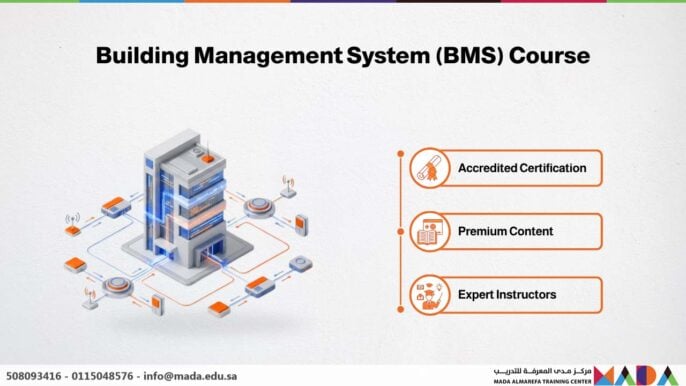
Course Overview:
The Building Management System (BMS) course is a specialized training program designed to meet the labor market’s demands in the operation and maintenance of smart building systems. This course provides engineers and technicians with the foundational theoretical knowledge required to understand the concepts and applications of integrated facility management systems. It aims to enhance their technical competence and help them keep pace with the rapid technological advancements in this field.
Course Objectives
- Understand the core concept and components of a Building Management System (BMS) and its importance in improving operational efficiency.
- Identify the various subsystems connected to the BMS platform, such as HVAC, lighting, security, and surveillance.
- Master the methods of automatic control and energy management through BMS.
- Develop the ability to read and interpret BMS-specific engineering drawings and schematics.
- Learn how to centrally operate systems and analyze data effectively.
- Recognize the selection and installation criteria for BMS systems suited for different types of projects.
- Develop theoretical skills to apply safety and efficiency principles within smart operating environments.
Course Curriculum
Day 1: Introduction to Building Management Systems (BMS)
- Definition of BMS and the types of systems utilized in smart buildings.
- The importance of utilizing building management systems to optimize energy consumption.
- Core system components: controllers, sensors, and monitoring displays.
- An overview of standard communication protocols (e.g., BACnet, Modbus).
Day 2: Systems Integrated with the BMS Platform
- Heating, Ventilation, and Air Conditioning (HVAC) systems and their integration with the BMS platform.
- Smart lighting systems and central control techniques.
- Security and surveillance systems (CCTV, alarm systems) and their integration with BMS.
- Water management and leak detection systems, and platform-based monitoring.
Day 3: Concepts of Automatic Control and Energy Management
- The concept of automatic control across various systems using BMS.
- Data collection and analysis techniques to optimize system performance.
- Energy-saving strategies and management via the BMS interface.
- Case studies of practical models in successful smart projects.
Day 4: Design and Programming of BMS Systems
- Steps for designing a BMS architecture based on specific project requirements.
- Reviewing engineering drawings and schematics for BMS installations.
- Working with standard Programming Interfaces.
- Understanding the concepts of system interoperability within the BMS platform.
Day 5: Maintenance, Sustainability, and the Future of BMS
- Principles of preventive and corrective maintenance for BMS operations.
- Tools for remote monitoring and advanced diagnostics.
- The future of smart buildings and the transition towards the Internet of Things (IoT).
- Modern trends in BMS applications for green and sustainable construction projects.

