
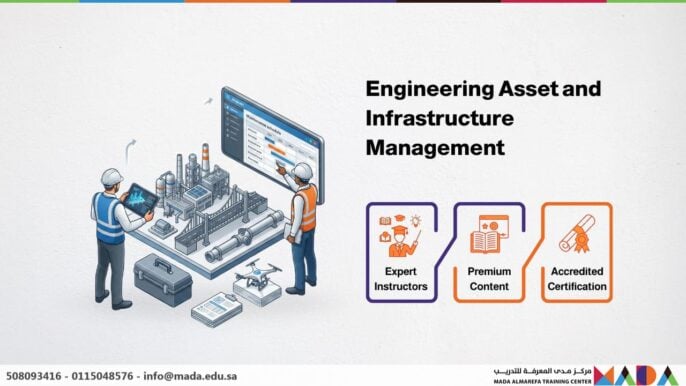
About the Course
The “Engineering Asset and Infrastructure Management” course is a premier opportunity to develop elite-level skills in managing large-scale engineering projects. In 2026, infrastructure isn’t just about building; it’s about sustaining. This program bridges the gap between technical maintenance and strategic business value, ensuring long-term project viability. Participants will gain a comprehensive understanding of modern management frameworks, helping them transform “liabilities” into high-performing “assets.”
[Image of the asset management lifecycle]
Course Objectives
- Understand the core principles and fundamentals of modern asset and infrastructure management.
- Acquire the analytical skills to perform Life Cycle Costing (LCC) for engineering assets.
- Learn to plan, organize, and optimize maintenance workflows while evaluating real-time performance.
- Develop the capacity to make data-driven investment decisions regarding infrastructure renewal and expansion.
- Align local operations with global best practices and ISO 55000 standards.
- Master the use of data analytics tools to support high-stakes strategic decision-making.
- Improve operational efficiency through the implementation of proactive asset health strategies.
Course Syllabus
Day 1: Introduction to Asset and Infrastructure Management
- The strategic definition of Engineering Assets and Infrastructure in 2026.
- The importance of asset management in both public utilities and private sectors.
- Navigating modern challenges: Aging infrastructure vs. increasing service demands.
- The role of Digital Twins and IoT in enhancing asset transparency.
Day 2: The Engineering Asset Lifecycle
Focusing on the financial and technical journey of an asset, where the total cost is often modeled as:
$$LCC = C_{initial} + \sum_{t=1}^{n} \frac{C_{ops,t} + C_{maint,t}}{(1+r)^t}$$
- Phases of the lifecycle: Design, Construction, Operation, and Disposal/Renewal.
- Technical condition assessment: Methods for auditing asset health.
- Risk analysis associated with legacy/aging infrastructure.
- Extension strategies: How to maximize the Useful Life of an engineering asset.
Day 3: Asset Management Systems (AMS)
- Overview of Asset Management Systems and their software architectures.
- In-depth review of ISO 55000: The international benchmark for asset management.
- Building a Strategic Asset Management Plan (SAMP).
- Integrating Information Systems (GIS, BIM, and ERP) for unified infrastructure oversight.
Day 4: Maintenance, Reliability, and Sustainability
- Transitioning from Corrective to Predictive and Prescriptive Maintenance.
- Leveraging Artificial Intelligence for smart maintenance scheduling.
- Sustainability principles: Reducing the environmental footprint of infrastructure operations.
- Cost-optimization: Balancing maintenance expenditure against the risk of failure.
Day 5: Decision-Making and Risk Management
Finalizing the strategy with robust risk frameworks and investment logic.
- Decision-support tools: Utilizing Net Present Value (NPV) and Multi-Criteria Analysis.
- Financial performance evaluation and capital expenditure (CAPEX) planning.
- Enterprise Risk Management (ERM) in infrastructure mega-projects.
- Future-proofing: Development strategies for next-generation resilient infrastructure.

