
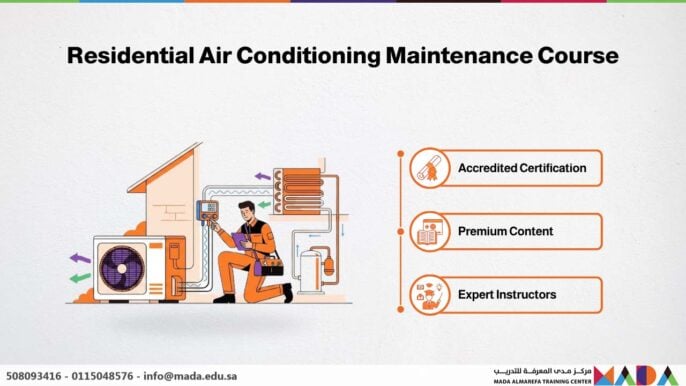
About the Course
The Residential Air Conditioning Maintenance course is a specialized program designed to meet the growing demands of the labor market in the installation and maintenance of HVAC (Heating, Ventilation, and Air Conditioning) systems.
This course provides participants with a real opportunity to master the fundamentals and advanced methodologies of residential AC maintenance effectively and efficiently. By gaining these high-demand skills, participants can unlock a wide range of career opportunities in a field that requires constant, year-round expertise.
Course Objectives
- Understand the primary components and structural design of residential air conditioning systems.
- Identify the core operational concepts of refrigeration and cooling cycles.
- Diagnose common mechanical and electrical faults in residential AC units.
- Apply preventive maintenance procedures to ensure peak system efficiency and longevity.
- Utilize specialized measurement and monitoring tools used in the HVAC industry.
- Recognize different types of AC units and learn the specific handling requirements for each.
- Develop professional communication skills for interacting with clients regarding maintenance issues.
Course Curriculum
Day 1: Introduction to Residential AC Systems
- The concept of air conditioning and its vital role in daily life.
- Overview of residential AC types: Split systems, Window units, and Portable/Floor-standing units.
- Explaining the functions of the Indoor Unit (Evaporator) and the Outdoor Unit (Condenser).
- Introduction to leading AC manufacturers and brands in the regional market.
Day 2: Electrical and Mechanical Components
- The Compressor: Types, importance, and operational role.
- The role of the Condenser and Evaporator in the heat exchange process.
- Types of refrigerants (Gases) used in modern cooling systems.
- Detailed explanation of the Refrigeration Cycle and how the entire system functions.
Day 3: Operating Principles and Control Systems
- Temperature regulation and the function of the Thermostat.
- Introduction to the electronic control board (PCB) and system logic.
- Understanding and interpreting system Error Codes for modern units.
- Signal processing and remote control interaction.
Day 4: Common Faults and Diagnostic Techniques
- Diagnosing High-Pressure and Low-Pressure circuit failures.
- Identifying gas leaks and professional leak-detection methods.
- Troubleshooting motors, internal fans, and external blowers.
- Analyzing the “No Cooling” symptom despite the device running—possible causes and solutions.
Day 5: Preventive Maintenance and Theoretical Repairs
- Step-by-step guide to periodic maintenance for residential units.
- Procedures for cleaning filters and a theoretical overview of refrigerant gas recharging.
- The importance of technical documentation, maintenance logs, and diagnostics.
- Essential safety tips when handling electrical components and pressurized systems.

