
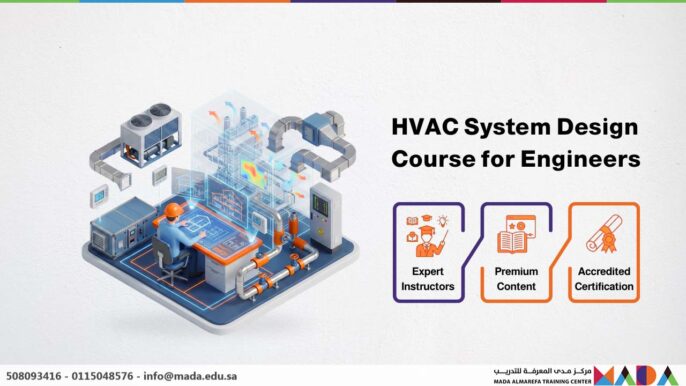
The HVAC System Design Course for Engineers offers a valuable opportunity to enhance technical skills and deepen understanding of modern systems used in temperature control and air quality management. The course content is closely aligned with labor market demands, thereby preparing engineers to efficiently design and analyze HVAC systems. It represents a critical step in the development of engineering personnel working in fields related to indoor energy and industrial climate control. Technicians are advised to refer to the HVAC Maintenance Course for Technicians for more suitable content.
Target Audience
The HVAC System Design Course for Engineers is designed for:
- Mechanical engineers working in design or implementation
- Engineers in industrial and commercial project sectors
- Energy engineers and thermal systems control specialists
- Maintenance engineers seeking to develop design and analytical skills
- Students and researchers in mechanical engineering and energy engineering disciplines
Course Modules
This five-day course covers the following key topics:
Day One: Introduction to HVAC Systems
- Concept and types of HVAC systems
- Importance of HVAC in industrial and residential projects
- The engineer’s role in the design and operation of cooling systems
- Review of basic concepts in thermodynamics and heat transfer
Day Two: Study of System Components and Their Functions
- Compressors: types and applications
- Condensers: various functions and configurations
- Expansion valves: types and operational principles
- Evaporators: their role in the cooling process
Day Three: HVAC System Design
- How to perform heat load calculations
- Selecting appropriate component sizes
- The impact of thermal insulation on system performance
- Principles of air distribution and duct design
Day Four: System Types and Energy Efficiency
- Comparison between central and local cooling systems
- Study of VRF systems and their benefits in large-scale projects
- Improving energy efficiency in HVAC systems
- Review of international efficiency standards (ASHRAE – ISO)
Day Five: Theoretical Operation and Maintenance of HVAC Systems
- Principles of effective HVAC system operation
- Preventive and corrective maintenance strategies
- Analysis of common system issues and theoretical solutions
- Introduction to software tools for performance simulation and analysis
Course Objectives
This course aims to enable participants to:
- Understand the fundamental principles of HVAC systems
- Gain the knowledge needed to analyze and design HVAC systems
- Learn about the latest technologies and equipment in the field
- Calculate heat loads and determine cooling requirements
- Study system components and select them according to engineering specifications
- Develop skills in performance analysis and efficiency improvement
- Enhance proficiency in using simulation software for system analysis
Course Impact
On the Trainee
This course equips you with advanced engineering knowledge to accurately and efficiently design and analyze HVAC systems, thereby elevating your professional competence in the engineering work environment.
On the Institution
It improves design quality and reduces implementation errors, enhances operational energy efficiency in projects, and strengthens the institution’s reliability and market reputation.
The HVAC System Design Course for Engineers is one of the most vital engineering programs, combining scientific principles with practical applications in energy and climate control fields. By acquiring these skills, you will be capable of designing integrated systems that achieve optimal operational efficiency and balance between performance and sustainability. Enroll now to advance your professional future in HVAC system design.

