
Course Overview
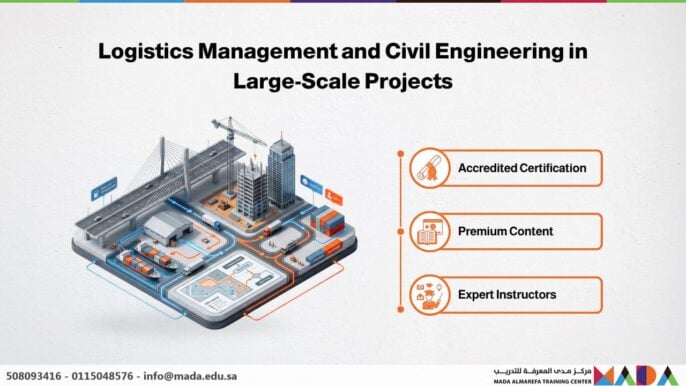
The “Logistics Management and Civil Engineering in Large-Scale Projects” course is a premier opportunity to enhance the proficiency of professionals in managing major projects. It provides practical content that bridges the gap between civil engineering theories and supply chain management applications. Delivered by the Mada Al-Ma’rifah Training Center, this course is specifically designed to meet the needs of the rapidly growing Saudi market, particularly in light of the massive expansion in mega-infrastructure projects such as Qiddiya and other Saudi Vision 2030 initiatives.
Course Objectives
-
- Understand the fundamental concepts of logistics management and its critical role in the success of large-scale projects.
- Apply effective engineering tools to optimize coordination and resource planning.
- Design flexible logistics systems tailored to the complex requirements of civil engineering projects.
- Analyze common challenges and develop strategies to overcome them effectively.
- Implement global best practices in inter-departmental coordination and workflow management.
- Enhance operational efficiency and reduce costs through well-researched logistical planning.
- Build a comprehensive action plan for managing large-scale projects using modern tools and methodologies.
Course Curriculum
Day 1: Introduction to Logistics and Civil Engineering
- Logistics concepts and their integration with infrastructure projects.
- The role of civil engineering in planning mega-projects.
- Identifying logistical requirements during the early stages of a project.
- Case Study: Analysis of a successful Saudi infrastructure project.
Day 2: Strategic Planning and Resource Management
- Strategic planning tools for large-scale projects.
- Techniques for efficient human and material resource management.
- Developing realistic and executable project schedules.
- Risk assessment and its impact on logistical planning.
Day 3: Logistical Operations in Field Execution
- Organizing workflow and site logistics.
- Supply chain management and ensuring material availability.
- Information technology for tracking and monitoring field operations.
- Practical Examples: Optimizing logistical performance in road and infrastructure projects.
Day 4: Departmental Integration and Organizational Structure
- Mechanisms for effective communication between diverse departments.
- Designing an organizational structure suited to project-specific needs.
- Utilizing leadership skills to manage multi-disciplinary teams.
- Case Study: A success story in large-scale project coordination.
Day 5: Performance Evaluation and Future Planning
- Key Performance Indicators (KPIs) in large-scale projects.
- Data analysis and measuring the efficiency of logistical operations.
- Developing future-proof plans based on lessons learned.
- Workshop: Preparing a comprehensive logistical plan for a simulated project.

