
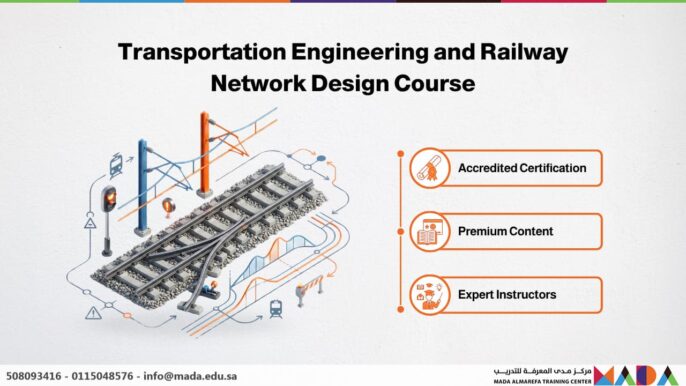
Course Overview
The Transportation Engineering and Railway Network Design course is a specialized program designed to develop the technical and engineering skills necessary to master modern transportation systems. This course provides participants with a robust foundation in the design and analysis of railway networks, aligned with the specific requirements of the Saudi labor market—particularly in light of the significant expansion of public transport and high-speed rail projects across the Kingdom.
Course Objectives
-
- Understand the fundamental principles of transportation engineering and railway systems.
- Utilize modern tools for railway network design and performance simulation.
- Analyze infrastructure requirements and determine appropriate engineering solutions.
- Study the environmental and economic dimensions of railway projects.
- Apply international safety and security standards in network design and operations.
- Prepare preliminary feasibility studies for rail transportation projects.
- Communicate effectively with stakeholders and engineering teams in large-scale projects.
Course Curriculum
Day 1: Principles of Transportation Engineering and Railway Networks
- Core concepts in transportation engineering.
- The historical evolution of railways globally and locally.
- Types of railway networks and their specific applications.
- The role of rail transport in driving economic development.
Day 2: Engineering Foundations for Railway Track Design
- Geometric elements of railway track alignment.
- Designing horizontal and vertical curves.
- Station site selection and integration with urban infrastructure.
- Soil evaluation and topographical analysis for tracks.
Day 3: Signaling and Control Systems in Railways
- Conventional and advanced signaling systems.
- Automated train control (ATC) technologies.
- Operational safety concepts and protocols.
- Introduction to Intelligent Transportation Systems (ITS).
Day 4: Economic Analysis and Project Feasibility Studies
- Cost-benefit analysis for railway infrastructure projects.
- Drafting preliminary feasibility studies.
- Assessing project impact on the environment and local communities.
- Reviewing Saudi project regulations, specifications, and standards.
Day 5: Practical Application and Network Design
- Using simulation software for network design and testing.
- Hands-on design of a small-scale railway project.
- Presentation of results and expert feedback sessions.
- Strategies for applying acquired knowledge to real-world infrastructure projects.

