
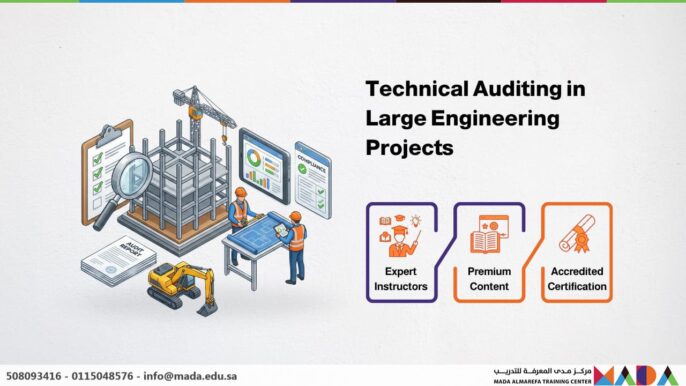
About the Course
The “Technical Auditing in Large Engineering Projects” course is a premium opportunity to elevate the efficiency of engineers and technicians working within the giga-project sector. In 2026, where precision and compliance are paramount, this program provides the essential skills to inspect and evaluate technical documentation with surgical accuracy. Participants will master auditing methodologies built on international best practices, significantly enhancing their professional value in a competitive global labor market.
Course Objectives
- Master the fundamental concepts and pillars of technical auditing in mega-scale projects.
- Acquire hands-on experience in reviewing complex engineering drawings and blueprints.
- Learn to analyze safety and quality requirements within the auditing workflow.
- Develop the capacity to draft high-precision, comprehensive technical audit reports.
- Enhance professional communication and technical coordination among project stakeholders.
- Familiarize yourself with international standards (ISO) used in technical compliance auditing.
- Understand the unique challenges of auditing “Mega” and “Giga” projects and how to navigate them.
Course Syllabus
Day 1: Introduction to Technical Auditing
- The strategic role of technical auditing in 2026 engineering frameworks.
- Quality Assurance (QA) vs. Quality Control (QC): Ensuring safety and longevity.
- Audit Types: Design Audit, Construction Audit, and Operational Audit.
- Modern auditing tools: Utilizing BIM and Digital Twin technology for compliance.
Day 2: Reviewing Technical Documents and Drawings
Focusing on Constructability Reviews to identify errors before site execution.
- Auditing Architectural, Mechanical, and Structural drawings for interdisciplinary clashes.
- Analyzing technical specifications and ensuring alignment with project “Basis of Design.”
- Verifying compliance with local building codes and international regulations (e.g., Eurocodes, IBC).
- Case Study: Analyzing and auditing documentation from a real-world flagship project.
Day 3: Safety and Quality Assessment
Evaluating risks using the Risk Priority Number (RPN) framework:
$$RPN = S \times O \times D$$
Where $S$ is Severity, $O$ is Occurrence, and $D$ is Detection.
- Global safety benchmarks in large-scale infrastructure and industrial projects.
- Auditing Quality Management Systems: Transitioning from ISO 9001 to ISO 45001.
- Ensuring adherence to preventative measures and site-specific safety protocols.
- Risk Analysis: Documenting technical observations and Non-Conformance Reports (NCR).
Day 4: Drafting Technical Audit Reports
Turning observations into actionable intelligence for project stakeholders.
- Steps to writing a professional, transparent, and comprehensive audit report.
- Prioritizing technical observations based on impact and urgency.
- Developing effective recommendations and corrective action plans.
- Reviewing model audit reports: Analyzing “Success Reports” from international consultants.
Day 5: Field Challenges and Practical Application
- Identifying common pitfalls and psychological challenges during the audit process.
- Managing cultural and linguistic diversity in multi-national technical teams.
- Full Simulation: Conducting a complete technical audit on a large-scale engineering module.
- Final technical assessment and trainee performance evaluation.

