
About the Course
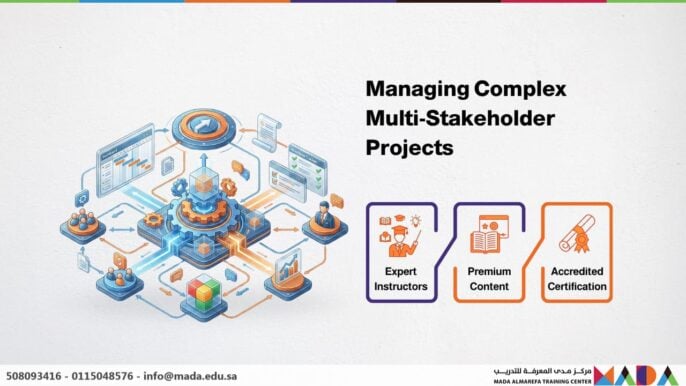
The “Managing Complex Multi-Stakeholder Projects” course is a premier opportunity to elevate the expertise of project management professionals. It provides advanced tools and skills to navigate projects involving multiple entities, complex organizational challenges, and high-stakes environments. Designed for the 2026 labor market, this course empowers executives and leaders to coordinate efforts across diverse organizations with efficiency, professionalism, and strategic foresight.
Course Objectives
- Understand the nature of complex, multi-stakeholder projects and their primary challenges.
- Apply effective methodologies to identify and engage stakeholders throughout all project phases.
- Build clear strategies for negotiation and conflict management among diverse partners.
- Utilize advanced leadership models to lead diverse and geographically distributed teams.
- Develop comprehensive project plans based on risk forecasting and Scenario Analysis.
- Enhance communication and direction skills among parties with conflicting interests.
- Periodically evaluate project performance to balance strategic and operational objectives.
Course Syllabus
Day 1: Understanding Project Complexity
- Core concepts: What defines a “Complex Multi-Stakeholder Project” in 2026?
- Identifying primary challenges: Power dynamics, organizational silos, and technical scale.
- Success and failure factors in mega-projects.
- Case Studies: Analysis of real-world successful and failed complex projects.
Day 2: Stakeholder Identification and Engagement
Focusing on the Power-Interest Matrix to prioritize engagement efforts.
- Techniques for identifying key project stakeholders.
- Categorizing stakeholders using the Power vs. Interest model.
- Utilizing the Stakeholder Engagement Matrix for proactive participation.
- Risk Assessment: Managing environmental and political risks in complex settings.
Day 3: Conflict Management and Negotiation Strategies
Transforming friction into collaborative momentum through proven resolution models.
- Types of conflicts in multi-stakeholder environments (Financial, Technical, Priority-based).
- Effective negotiation strategies: Moving from “Position” to “Interest.”
- Constructive conflict resolution techniques.
- Interactive Simulation: A hands-on negotiation exercise for complex projects.
Day 4: Leadership and Guidance in Complex Environments
- High-level leadership skills for large-scale, high-pressure environments.
- Leading Cross-Cultural and multi-disciplinary teams.
- Strategic orientation tools for maintaining project vision.
- Case Study: Leading a multi-national engineering or infrastructure project.
Day 5: Execution Planning and Performance Evaluation
Utilizing Scenario Analysis to ensure plan flexibility.
- Building an integrated, flexible execution plan.
- Continuous evaluation tools and 2026 Project Management KPIs.
- Risk Management: Utilizing scenario-based modeling to anticipate future disruptions.
- Workshop: Designing a complex project roadmap using modern digital management tools.

