
About the Course
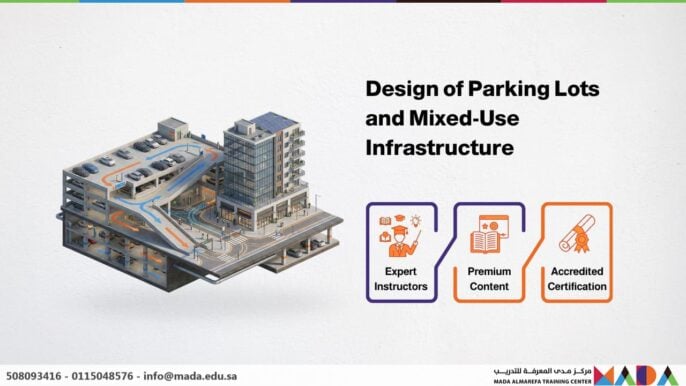
The “Design of Parking Lots and Mixed-Use Infrastructure” course is a strategic opportunity to develop theoretical and practical skills in modern urban planning. In 2026, infrastructure is no longer uni-functional; it must be adaptive. This program, offered by the Mada Al-Maarifa Training Center, provides engineers and architects with an in-depth academic framework to design multi-functional facilities that address the spatial and operational challenges of mega-projects.
Course Objectives
- Understand the theoretical foundations for designing safe and efficient parking systems.
- Master the principles of spatial and functional planning for mixed-use infrastructure.
- Apply modern international standards in evaluating design quality and structural feasibility.
- Integrate sustainability and “Green Urbanism” concepts into infrastructure projects.
- Identify and mitigate technical and regulatory hurdles in large-scale urban developments.
- Develop the ability to analyze, audit, and optimize model designs for maximum efficiency.
- Bridge the gap between traditional civil engineering and smart-city innovation.
Course Syllabus
Day 1: Introduction to Modern Parking and Infrastructure
- The evolution of parking design in 2026 smart cities.
- The strategic importance of multi-use infrastructure in high-density urban areas.
- The intersection of Urban Planning and parking facility design.
- Reviewing regional and international case studies: Lessons from flagship projects.
Day 2: Needs Analysis and Preliminary Planning
Focusing on data-driven forecasting to ensure long-term facility viability.
- Forecasting vehicle density and future growth patterns.
- Spatial analysis: Classifying available land and underground potential.
- Site Selection: Criteria for optimizing the location of multi-use hubs.
- Establishing preliminary project roadmaps and execution frameworks.
Day 3: Spatial and Functional Design Principles
Optimizing Circulation: Ensuring smooth flow for both vehicles and pedestrians.
- Organizing internal and external spaces for maximum capacity.
- Designing internal traffic flow: Ramps, turning radii, and signage logic.
- Allocating service units and retail components within infrastructure layers.
- Utilizing analytical tools to evaluate design performance and bottlenecks.
Day 4: Safety, Sustainability, and Accessibility
- Safety standards: Fire protection, ventilation, and structural resilience in garages.
- Sustainability: Integrating EV charging stations and eco-friendly construction materials.
- Implementing Universal Design to ensure accessibility for all users (POD).
- Economic sustainability: Strategies for revenue-generating multi-use spaces.
Day 5: Field Challenges and Smart Design Futures
- Comparative analysis of successful global projects.
- Identifying field-specific challenges: Soil conditions, drainage, and structural constraints.
- Retrofitting: Strategies for upgrading existing parking sites to smart hubs.
- The future of Smart Parking: AI integration, automated valet, and 2026 trends.

