
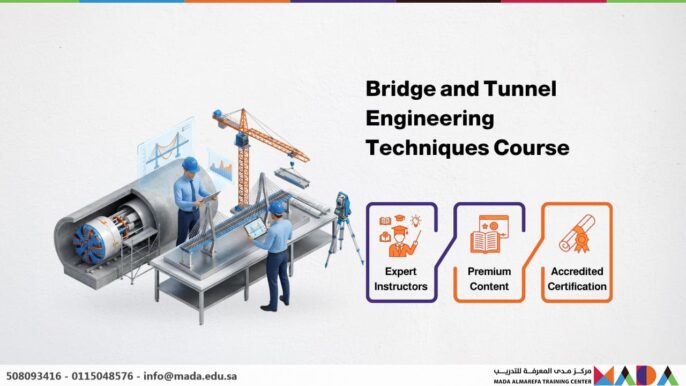
About the Course
The “Bridge and Tunnel Engineering Techniques” course is a premier gateway for engineering students and infrastructure professionals to master the fundamental theoretical frameworks of modern connectivity projects. Designed to meet the 2026 labor market’s demand for specialized expertise, this course focuses on the advanced methodologies used in the design, analysis, and execution of some of the most challenging structural projects in the world.
Course Objectives
-
- Understand the fundamental principles and mechanics of bridge and tunnel engineering.
- Acquire the necessary skills for Load Analysis and core structural design.
- Identify various bridge types and their specific structural characteristics.
- Study and select optimal materials for long-span and underground structures.
- Learn the basics of utilizing engineering software for structural simulations.
- Master the initial planning phases and feasibility studies for mega-infrastructure projects.
- Identify common engineering challenges and learn proactive mitigation strategies.
Course Syllabus
Day 1: Introduction to Bridge and Tunnel Engineering
- Defining the sciences behind modern bridge and tunnel systems.
- The strategic role of bridges and tunnels in 2026 smart-city infrastructures.
- Classifying bridges by utility, material, and structural form (Arch, Suspension, Cable-stayed).
- Fundamentals of underground excavation and tunnel engineering techniques.
Day 2: Structural Analysis and Primary Frameworks
Focusing on how structures maintain equilibrium under extreme conditions.
- Overview of primary structural systems used in heavy infrastructure.
- Analyzing Static and Dynamic Loads (Gravity, Wind, and Traffic).
- Concepts of equilibrium, stability, and structural integrity.
- Preliminary review of support systems, abutments, and lateral bracing.
Day 3: Construction Materials and Theoretical Execution
- High-performance materials: Reinforced concrete, structural steel, and composites.
- Material properties: Durability, tension, and compression in mega-projects.
- Comparative analysis: Traditional materials vs. 2026 smart-materials.
- The lifecycle of a project: From conceptual design to theoretical execution.
Day 4: Strategic Planning and Technical Assessment
- Establishing preliminary blueprints for bridge and tunnel networks.
- Technical criteria for site selection: Topography and geological constraints.
- Conducting technical and economic feasibility studies.
- Safety and safety-by-design standards in the planning phase.
Day 5: Modern Technologies and Future Challenges
- Introduction to computer-aided engineering (CAE) in bridge analysis.
- Key engineering challenges in deep-tunneling and underwater crossings.
- The impact of Geotechnical and Environmental factors on design stability.
- The future of infrastructure: Digital twins and smart-monitoring in the Arab world.

