
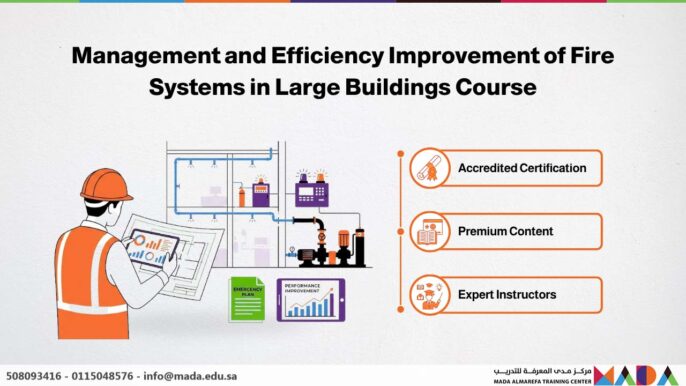
About the Course
The Management and Efficiency Improvement of Fire Systems in Large Buildings course offers a specialized opportunity for engineers and technicians to master the operational and maintenance frameworks of fire safety systems. This program is directly tailored to the high-stakes requirements of the real estate and industrial sectors, fostering a workforce capable of optimizing system performance while ensuring strict compliance with global standards.
With insights from experts at the Mada Al-Ma’rifah Training Center, participants will gain the essential theoretical skills needed to analyze and develop fire prevention systems with high precision and efficiency.
Course Objectives
- Understand the fundamental principles of fire systems and their operational mechanics.
- Analyze the technical requirements of fire protection systems specifically for large-scale facilities.
- Apply performance evaluation methodologies to identify and mitigate vulnerabilities in existing systems.
- Master the management and efficiency improvement of fire systems using modern diagnostic tools.
- Develop robust maintenance plans that minimize risk and maximize operational longevity.
- Gain familiarity with local and international fire protection codes and specifications.
- Prepare detailed analytical reports regarding system health and proposed modernization strategies.
Course Curriculum
Day 1: Fundamentals and Types of Fire Systems
- Introduction to fire protection systems and their critical role in large-scale infrastructure.
- Classification of fire systems: Sprinklers, standpipes, detection sensors, and suppression units.
- System architecture: Understanding the function of each component within the integrated network.
- Common challenges in the design and operation of complex fire systems.
Day 2: Design Requirements and Safety Standards
- Reviewing international standards (e.g., NFPA, IBC) and their impact on architectural design.
- Determining specific safety needs for different building types (Administrative, Industrial, Residential).
- Designing fire systems for expansive areas and public facilities.
- The concept of “Smart Design” for fire safety in landmark buildings.
Day 3: Efficient System Operation
- Standard Operating Procedures (SOPs) for fire systems post-installation.
- Centralized monitoring and control mechanisms for fire protection.
- The role of modern technology in optimizing operational performance.
- Case studies on successful operational management in large-scale facilities.
Day 4: Preventive and Corrective Maintenance
- The philosophy of preventive maintenance and its role in risk reduction.
- Core steps for establishing a comprehensive fire system maintenance program.
- Advanced fault detection techniques and troubleshooting methodologies.
- Evaluating maintenance costs and improving the Return on Investment (ROI).
Day 5: Performance Optimization and Future Trends
- Measuring system efficiency using Key Performance Indicators (KPIs).
- Integrating Big Data and the Internet of Things (IoT) for performance enhancement.
- Strategies for retrofitting legacy systems and integrating smart solutions.
- The future of fire protection in Smart Cities and Sustainable Buildings.

