
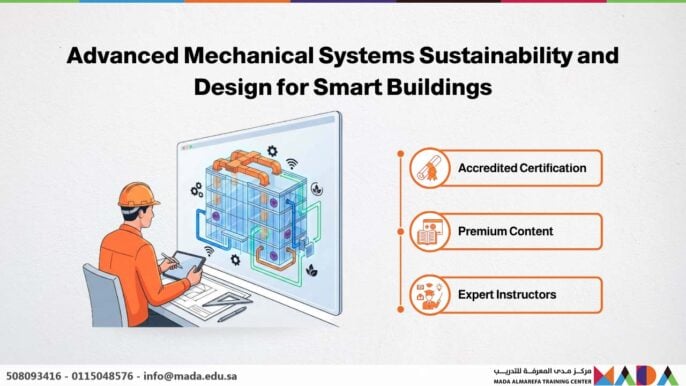
Course Overview
The Advanced Mechanical Systems Sustainability and Design for Smart Buildings course offers a unique opportunity for engineers and technicians to keep pace with the latest developments in sustainable mechanical design within smart facilities. The course focuses on theoretical foundations, explaining core concepts of energy, efficiency, and modern technology used in the design of HVAC (Heating, Ventilation, and Air Conditioning) systems. This program is specifically designed to meet the growing market demand for qualified professionals capable of developing smart, sustainable solutions within the engineering sector.
Course Objectives
- Understand sustainability concepts and their application in modern mechanical system design.
- Identify the components and systems of smart buildings and their role in enhancing energy efficiency.
- Analyze thermal performance and HVAC requirements in smart urban projects.
- Utilize analytical tools and software to optimize mechanical system designs.
- Evaluate design compliance with international environmental standards such as LEED and GSAS.
- Design air distribution and heating systems based on energy-saving technologies.
- Prepare technical reports on the efficiency of mechanical systems and their environmental impact.
Course Outline
Day 1: Introduction to Smart Buildings and Sustainability
- The concept of smart buildings and their significance in the 21st century.
- The relationship between sustainability and mechanical systems engineering.
- Market challenges in designing modern mechanical systems.
- An overview of international standards for sustainable construction.
Day 2: Designing Smart HVAC Systems
- Fundamentals of HVAC design in smart building environments.
- Selecting appropriate equipment for maximum energy efficiency.
- The role of Automation and Control Systems in regulating temperature and humidity.
- Case Study: Optimizing HVAC performance in an administrative building.
Day 3: Energy Efficiency Analysis for Mechanical Systems
- Energy performance analysis tools using modern software.
- Methodologies for calculating building heat loads.
- Reducing energy loss in distribution and transport systems.
- The concept of Solar Cooling and its future applications.
Day 4: Water and Energy Conservation Technologies
- Designing Greywater Recycling systems for reuse.
- Integrating solar energy into mechanical system operations.
- Thermal insulation techniques and their impact on energy efficiency.
- Reviewing global innovations in conservation technologies.
Day 5: Applied and Analytical Applications for Smart Mechanical Systems
- Designing a smart building prototype using simulation tools.
- Studying the integration of mechanical systems with lighting and security networks.
- Analyzing the impact of design on both internal and external environments.
- Comprehensive review of future challenges and solutions in sustainability.

